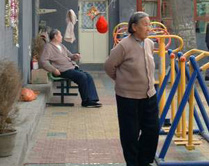
That an old couple of over 70 fell at their Shanghai home and died of delayed emergency aid last week received enormous news coverage and aroused widespread social concern for Chinese "empty nesters".
"Empty nesters" refers to senior citizens in a family without children around, including both the married and the widowed.
China has at least 23.4 million "empty nesters" and the number is still growing, statistics showed.
In Tianjin, 54 percent of senior citizens lived apart from their children in 1997. This figure rose to 62.5 percent in 2002 and is estimated to hit 90 percent in ten years.
Currently, the empty nester group is expanding quantitatively and proportionately, said He Maishou, a professor on aging with the Tianjin Academy of Social Sciences.
The empty nesters are concerned by three major problems, namely financial inadequacy, lack of physical care and insufficient emotional support, experts said.
In Beijing alone, among 6,000 elderly people who survive on the guaranteed subsistence allowances for needy urban residents, 4,500 are empty nesters.
The problem becomes even more severe when it comes to rural families, whose elderly normally do not have old-age pensions.
Senility often comes suddenly and senior citizens' lives are immediately under threat if they live by themselves, said Xu Qin, an aging expert who has been keeping following the empty nest syndrome.
Meanwhile, depression is another killer, Xu said. As people grow old, their social ties with the old work units and the neighbors loosen. Empty nesters are likely to feel depressed since they have nobody to talk to and nothing to do.
Experts said the empty nest problem is related to family, community, government and the society as a whole and requires joint efforts from all parties concerned.
Professor He said the traditional vertical support of elderly people, in which the responsibility falls on the children and the work units, is supposed to switch to modern horizontal style, which consists of mutual care within a couple and care from the local community.
Chongwai Community in Beijing has established an efficient mechanism.
They installed an "emergency bell" in the home of every empty nester, which is linked to an active community member.
Their work paid off when 73-year-old Grandma Lu, who lived by herself, suffered from a heart problem one night several days ago. She pressed the "emergency bell", and her neighbor Cui sent her to the hospital.
"If not for Cui and for the emergency bell, I might have died," she said.
Various services including haircuts, shopping and cooking are also available through the "emergency bell".
(Xinhua News Agency October 7, 2003)
|