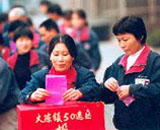
The year 2001 has seen grassroots democracy expanding from rural parts of China to urban areas, a move described by sociologists as a breakthrough in the country's political system. Thousands of residents in several cities, such as Shanghai, Nanjing, Hangzhou, etc, elected their community councils and leading council officials for the first time on Chinese mainland in 2001. The election reflects respect for the will of residents.
In a circular issued at the end of last year, the Chinese government urged cities across the country to reform the community management system by setting up self-governing organizations through democratic elections.
Gu Yingchun, a sociologist, said that "the move is conducive to promoting the construction of the urban political system."
"What's more important is that the practice of direct election has been expanded from rural China to the urban part of the country, resulting in the expansion of the grassroots democracy in China and an important breakthrough in China's construction of democratic politics," Gu said.
During a recent community-level election in Jingfang community in Hangzhou, a 15-member council, five-member community committee and head of the committee were elected out of 39 candidates by secret ballot.
The candidates in Jinfang, the only community selected from the province to hold such an election, were chosen by an election committing made up of local urban residents.
Before votes were cast, several hundred residents gathered at a local primary school, where each of the six smiling but apparently nervous candidates made a three-minute campaign speech on what they would do for the community if elected.
They were competing for the post of the head of the Jingfang Community Committee, a job described last year by Chinese Premier Zhu Rongji as the "prime minister" of a community.
Nearly 80 percent of the families in the community, or 1,280 households to be exact, voted during the election and the results were announced on the spot.
Feng Zirong, a 66-year-old retired worker, said the election has demonstrated the respect for the will of the residents.
According to a local regulation, the head of the neighborhood committee must report each month to the community council on the work of the committee.
Bao Hong, a 63-year-old retired engineer and member of the council, said the officials of the committee used to be appointed by the higher government and they report only to the higher government.
"It is different now. The elected neighborhood committee would naturally report to its electorate. If any of those on the committee does not do a good job, we would vote him or her out," she said.
The experience of casting votes for community leaders may be a novelty for about 400 million Chinese urban residents, but not for their 900 million rural counterparts.
Wang Jinhua, an official in charge of community elections with the Ministry of Civil Affairs, said Chinese farmers began to elect village leaders as early as 1988, and almost all of the 730,000 villages have elected heads of village committees.
(People’s Daily December 12, 2001)