| Home / Government / Focus News | Tools: Save | Print | E-mail | Most Read |
| Wen: Water Quality a Major Priority |
| Adjust font size: |
The management of the country's fresh water supplies should now be a major national priority and handled as a "State project", Premier Wen Jiabao said.
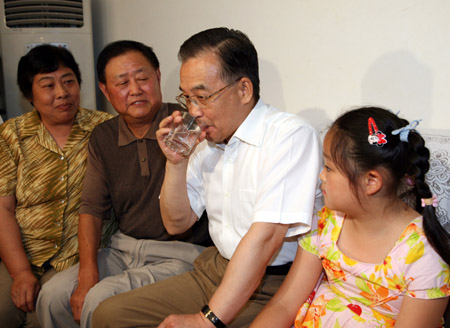
Premier Wen Jiabao drinks boiled tap water at a resident's home to inspect the water quality in Wuxi, east China's Jiangsu Province, June 29, 2007. An algae bloom contaminated the Taihu Lake a month earlier and halted water supply for two million people in the lakeside city of Wuxi.
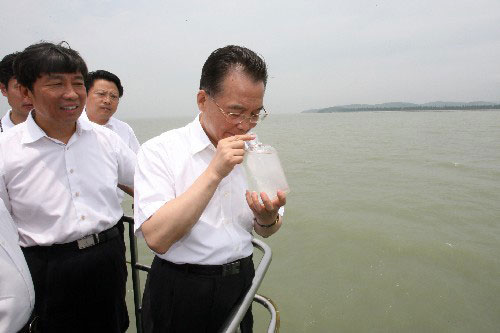
Wen samples water from the Taihu Lake which has been polluted with algae a month earlier, in Wuxi, east China's Jiangsu Province, June 29, 2007. Wen urged officials to take environmental management of the country's freshwater. Since May, blue-green algae outbreaks have been reported in eastern Taihu Lake, Chaohu Lake and southwestern Dianchi Lake. Pollution has largely been to blame. "We need to take environmental management of the three lakes as a state project and put it at a more prominent, pressing and important position," Wen said at a meeting over the weekend on pollution control work of the three lakes in Wuxi of east China's Jiangsu Province. "We should tackle the problem with scientific approach, good leadership, and high standards and confidence." The priority is to protect the lakes from further pollution and ensure the safety of drinking water for the local residents, Wen said. At the meeting, Wen instructed local officials to "strengthen supervision and ban factories from discharging pollutants into the lakes". He also urged strengthened efforts to draft regulations on the environmental protection of the three lakes. Stung by a series of water crises, the country will adopt a new national compulsory drinking water safety standard from this month to secure safe water supplies for citizens. The new standard is the first amendment to the outdated former one, enacted in 1985. According to the amendments, a total of 106 parameters have been developed. "Safe drinking water is vital to people's health and, to a great extent, important to social stability as it's one of the primary and basic needs for human survival," Wang Xuening, deputy director general of the Bureau of Health Supervision under the Ministry of Health (MOH), said. "Given the fact that amending work headed by MOH has convened specialists in fields like public health, environment protection, and water supply, and has solicited public opinions as well, the long-anticipated new standard would further improve the nation's drinking water safety and finally enhance people's quality of life." Chen Changjie, a researcher on environment protection with the Chinese Center for Disease Control and Prevention, told China Daily that when all the parameters under the new standard are fully met, people should be able to drink water straight from the faucet. "To be more exact, the tap water is safe to drink without boiling with the pretext of no second-time contamination during the transfusion, as long as the 42 regular parameters under the new standard are met," Chen said. "Most of the time, the water fresh from the supplier is up to the standard and safe for direct use. However, the pipes used to deliver the water to the consumer remains substandard." It is recommended that in the meantime, water intended for drinking should be boiled, Chen added. The new standards define the basic condition of drinking water and safe quality on a national basis. Other secondary parameters are devolved to provincial governments and given regional variations. It is expected that all standards be fully implemented nationally by 2012. (China Daily, Xinhua News Agency July 2, 2007) |
| Tools: Save | Print | E-mail | Most Read |
| Related Stories |
|
||||
|
|
||||||||||||
|
| Links | |||||||||||
|
