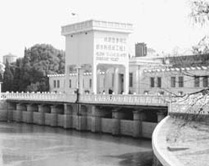
 Looking back into the past 50 hard years of the struggle harnessing the Yangtze, a giant South-North Water Diversion Project rises suddenly in view. A whimsical idea no more since the project is going to kick off with its East Route some days off this year.
How has the project's scale been determined? There are abundant water resources to be counted on, and such factors as minimum demand, potentials to be tapped and capabilities to bring pollution under control by the recipient areas. Things have all been looked into from a scientific approach beyond doubt, from various angles and in a planned way as a whole. According to scientists, China's north had suffered from a lack of 5.1 billion cubic meters of water in 2000, including 3.6 billion cubic meters of water extracted from underground, 1.5 billion cubic meters of water cut from agriculture and ecology. It is estimated that water shortages in China's recipient areas by 2010 would amount to 11.2 billion cubic meters and as many as 19.2 cubic meters by 2030.
The East Route as planned is going to be opened up in areas economically developed. But resultant pollution as a matter of public concern has to be seriously treated to ensure guaranteed supply of quality water, clean and unpolluted, and according to plans. It is reported that 369 projects are to be built with a total of 24 billion yuan (US$2.9 billion) to be allocated to build the East Route. It is told the first-phase project as has been planned is to use 14 billion yuan (US$1.69 billion) toward the goal of putting water supply through the whole trunk line of East Route in recipient areas to measure up to state's potable quality demands.
Water will be at a varied price level according to demands, supply amount and related costs involved as it runs through the recipient areas. Possible conveniences are to be provided as issuance of loans at a minimum interest rate and no burdens should be imposed weighing on the users.
As ruled on by the state, investments will be made on the basis of the lengths of watercourse to be built and water supply amounts provided. A cost outlet pricing system is to be instituted. By preliminary estimates, Shandong Province will have an outlet price averaging 0.60 yuan (US$0.07) per cubic meter of water from the trunk line of East Route. On the trunk line of central East Route north of the Yellow River an outlet price averaging 0.20 yuan (US$0.02) per cubic meter is estimated. Water supply to the north of the Yellow River will be at an average outlet price of 0.70 per cubic meter. Costs incurred as those of facilities and networks for water supply and putting pollution under control will also be included as a determining factor deciding on water pricing acceptable to recipients set by the state.
(People's Daily December 11, 2002)
|