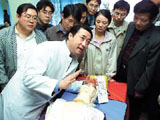
 More than 400 doctors from across China Thursday attended a training program in Shanghai, on a new international guideline on first aid in case of heart or lung failure.
Cardio-pulmonary Cerebral Resuscitation, or CPCR, is the most elementary and practical first aid skill to revive patients suffering from sudden circulatory or respiratory arrest.
Previously, there was no global unified standard on first aid. Each country had its own criteria, with China following the United States.
To provide the medical community with an optimal life-saving first aid, the American College of Cardiology in 1999 invited specialists from around the world to compile the first international framework for CPCR. It was released in October last year.
The four-day training program, organized by the Health Ministry and the Chinese Medical Association, aims to promote the new policy among medical staff to improve the success rate in first aid.
In China, only 10 million people, 0.8 percent of the population, are adept at life-saving skills. Just 10 percent of medical staff have the capability to render effective first aid.
In contrast, nearly 10 percent Americans are good at it.
"First aid skills and outcome are still quite low in the world. The highest recovery rate for sudden cardio-pulmonary arrest is only 3.5 percent in the United States, while it is almost zero in China," said Dr. Liu Zhongmin from Shanghai East Hospital, who was among two domestic specialists invited to compile the guideline.
The new guideline focuses on first aid without equipment and alters some traditional medication that is given during the patient's recuperation.
Doctors said the sooner resuscitation is given after a sudden heart or lung arrest, the better the chances of survival.
"While patients can regain their heart beat or breath even after 10 minutes, they can suffer permanent brain damage if blood supply is not restored in 5 minutes," Liu said. "Under such circumstances, the patient may survive but life will be difficult."
Basic life support without equipment, such as direct mouth-to-mouth resuscitation and chest compression, is highly effective.
"For a long time, we were told that a huge dose of epinephrine is required to revive a dying patient. But this has side effects on the kidney and brain," said Liu. The new guideline clarifies that a small dosage is enough and suggests discontinuation of the medicine in case it is not effective, he added.
The picture shows that Dr. Liu Zhongmin from Shanghai East Hospital was explaining first aid skills to medical staff during a training program Thursday.
(eastday.com November 9, 2001)