| Tools: Save | Print | E-mail | Most Read |
| Breast-feeding Rights Highlighted |
| Adjust font size: |
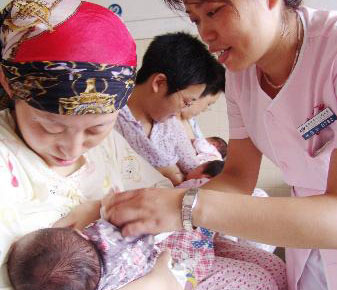
Nestle and five other breast milk substitute producers in a letter of commitment signed in Beijing on Saturday vowed not to publish commercials on breast-milk substitutes or do anything which could impinge on the rights of mums to breast feed their babies. The signing was part of an event held by the Ministry of Health, the World Health Organization (WHO) and the United Nations Children's Fund (UNICEF) to mark the 25th anniversary of the International Code of Marketing of Breast-milk Substitutes and celebrate World Breast-breeding Week which has been running from August 1-7. It's contended that breast milk with the nutrients and antibodies it provides is the best and safest way to start a human life. However, commercials for substitutes to breast-milk such as milk and rice powders use idealistic images which could mislead young mothers into giving up on breast-feeding. The International Code of Marketing of Breast Milk Substitutes was passed at the 34th World Health Assembly in 1981. China's Management Rules on Marketing of Breast Milk Substitutes, which took effect in 1995, also proposed several limitations on the marketing of breast milk substitutes including a ban on commercials. Despite breast-feeding publicity and supervision implemented to curb misleading and possibly illegal commercials such advertisements still widely exist and figures show the rate of breast-feeding has fallen in recent years. "The WHO appreciates the Chinese Government's position in breast-feeding promotion," said Cristobel Tunon, a senior official with the WHO Regional Office in China. "It not only gives words but also takes actions to improve children's health in the country with the largest population in the world which is beneficial to the UN's millennial goal for childrens' health. However, we cannot deny that great challenges are still ahead."
Breast-feeding can save 3,500 children's lives worldwide per day making it much more powerful than any other precautionary measures, Tunon said. "If the rate of breast-feeding reaches 90 percent in the whole of China infant mortality will be reduced by 4 percent meaning 21,600 children per year or 60 per day." Koen Vanormelingen, chief of the Health and Nutrition Section of the UNICEF Office for China, told China Daily. "High work pressure on women, inadequacy of maternity leave and lack of baby-friendliness in the workplace are important factors," said Vanormelingen. "But the lack of consumer awareness of the importance of breast-feeding and the lack of enforcement of China's Management Rules on the Marketing of Breast-milk Substitutes are also among causes of the decrease." "The principle of 'First Call for Children' needs to be implemented," said Wan Yan, deputy director of the Committee on Women and Children under the State Council, "and popularization of breast-feeding is a long-term program asking for social responsibility." (China Daily August 7, 2006) |
| Tools: Save | Print | E-mail | Most Read |
 |
| Related Stories |
|
| Product Directory China Search |
Country Search Hot Buys |
