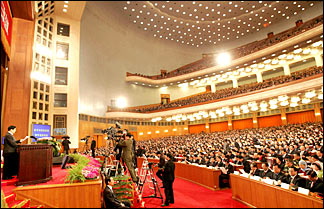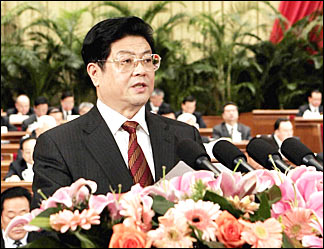
China will use non-peaceful other necessary means in the event that "Taiwan independence" forces take action leading to the island's secession from China, according to Vice Chairman Wang Zhaoguo of the Standing Committee of the National People's Congress (NPC). Wang was speaking on Tuesday in Beijing as he explained the proposed Anti-Secession Law to the NPC and Chinese People's Political Consultative Conference (CPPCC).
The draft law states that China would also use non-peaceful means should major incidents entailing Taiwan's secession occur, or should possibilities for a peaceful reunification be completely exhausted.
Under those circumstances, "the state shall employ non-peaceful means and other necessary measures to protect China's sovereignty and territorial integrity," Wang said.
The Taiwan question is one left over from China's civil war of the late 1940s. Resolving the Taiwan question and accomplishing China's complete reunification is one of the three historic tasks of the Communist Party of China and the country.
Over the years China has hoped to develop stronger relations across the Taiwan Straits and promote a peaceful reunification of the motherland. However, in recent years the Taiwan authorities have intensified activities aimed at separating Taiwan from China.
"Using non-peaceful means to stop secession in defense of our sovereignty and territorial integrity would be our last resort, when all our efforts for a peaceful reunification prove futile," Wang said. "No one is more desirous of achieving a peaceful reunification than we are."
But Wang stressed that no sovereign state can tolerate secession and every sovereign state has the right to use necessary means to defend its territorial integrity.
The draft states that China will do its utmost to protect Taiwan civilians and foreign nationals, their property and other interests in Taiwan should non-peaceful means be used. Taiwan compatriots in other parts of China would be entitled to the same protection.
The law has been in the works for years, as its writers have reworked the draft to incorporate suggestions from NPC deputies, members of the National Committee of the CPPCC, specialists, average citizens and overseas Chinese communities.
General Secretary Hu Jintao of the Communist Party Central Committee chaired a forum for leaders of the central committee of China's non-communist parties, the All-China Federation of Industry and Commerce and selected persons with no party affiliation. Wu Bangguo, chairman of the NPC Standing Committee, convened several workshops and meetings to listen to the opinions of leading local officials, jurists and Taiwan specialists and others.
At its 13th meeting, the NPC Standing Committee unanimously approved the Anti-Secession Law draft and decided to submit it to this NPC session for deliberation, Wang said.
Full text of Anti-Secession Law explanations
Four-point Guidelines on Cross-Straits Relations Set Forth by President Hu
(Xinhua News Agency March 8, 2005)
|