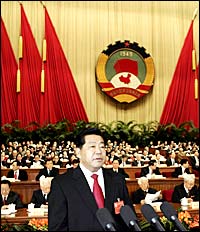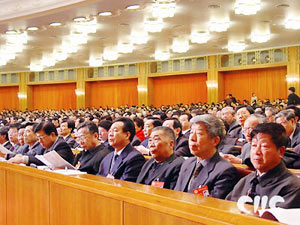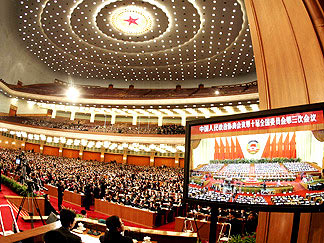
China's top advisory body, the National Committee of the 10th Chinese People's Political Consultative Conference (CPPCC), convened its Third Session in Beijing on Thursday afternoon, laying much stress on the role it can play in promoting national reunification and social harmony.
"We shall bring our unique function and role into full play ... contribute to the building of a harmonious socialist society ... oppose and curb Taiwan independence activities and safeguard peace and stability across the Taiwan Straits," said Jia Qinglin, chairman of the CPPCC National Committee, while delivering a keynote report on what the advisory body should do in 2005.
All top leaders of the ruling Communist Party of China (CPC) and the state, including President Hu Jintao, top lawmaker Wu Bangguo and Premier Wen Jiabao, were seated on the central rostrum when the session opened in the Great Hall of the People at 3 PM.
Founded in 1949, the CPPCC consists of members of society who are willing to serve as a think tank for the government and for the country's legislative and judicial organs.
As an open forum where the CPC, non-Communist parties and people without party affiliation can discuss state affairs freely and on an equal footing, the CPPCC is also regarded as an example of Chinese socialist democracy.
However, Jia, also a member of the CPC's top decision-making body, the Standing Committee of the Political Bureau of the CPC Central Committee, also reaffirmed the unshakable leadership of the CPC over the advisory body.
"Adherence to the leadership of the CPC provides a fundamental guarantee for the healthy development of the cause of the people's political consultation," he told the 2,186 advisors from all over the country.
The CPPCC has enhanced unity and friendship with Hong Kong, Macao and Taiwan over the past year and played its role in implementing the "one country, two systems" policy and promoting reunification of the motherland, Jia said.
The two special administrative regions (SARs) of Hong Kong and Macao have made new progress in implementing the basic principle of "one country, two systems" and achieved a high degree of self-administration and autonomy, Jia said in his work report.
In 2004, the Standing Committee of the National People's Congress (NPC) gave interpretations of the Hong Kong SAR's Basic Law and outlined its electoral methods for 2007 and 2008 in another important move to resolve issues of constitutional development there.
The successful election of the Hong Kong SAR's third legislative council and inauguration of the second-term government of the Macao SAR have cemented the status of patriotic forces in the political lives of the two SARs, said the CPPCC National Committee chairman.
"Members of the CPPCC National Committee from Hong Kong and Macao have played an active role by firmly abiding by the Basic Laws and supporting the central and SAR governments in resolving related issues in compliance with the law," he said, "They have contributed to the maintenance of social stability and promotion of prosperity in the two SARs."
Jia acknowledged that the advisory body, over the past year, has carried out work in various fields and also addressed the current situation across the Taiwan Straits to promote peaceful reunification of the motherland.
"We organized investigations and study tours among CPPCC National Committee members and strengthened with research and publicity work on the glorious culture and traditions of the Chinese nation to fight Taiwan independence from historical and cultural perspectives," he said.
Meanwhile, the CPPCC National Committee also promoted economic, technological and cultural as well as personnel exchanges across the Taiwan Straits to increase Taiwan compatriots' understanding of the Chinese mainland's policy on Taiwan and dispel skepticism and misunderstanding on certain issues.
It is the common aspiration of diverse parties, political and ethnic groups and all circles to see the complete reunification of the motherland, he said. "Some non-Communist parties and members of the CPPCC National Committee have, at CPPCC meetings or in proposals, called for the earliest draft of an Anti-secession Law to fight and curb secessionist activities."
In 2004, the CPPCC National Committee sent a total of 29 delegations to visit 44 countries and received 28 groups of visitors from 23 countries and three international organizations. It also established new relations with six countries and 13 organizations and institutions.
In its history, the 56-year-old advisory body has established friendly contact with 184 institutions from 107 countries and eight international and regional organizations. (Xinhua News Agency March 3, 2005)
|