Fang Xiangming, deputy general manager of the China Aerospace Science and Industry Corporation (CASIC), the primary initiator China's participation in the Galileo project, said that the country welcomes the EU's satellite navigation system as a significant boost for industries like transport and communications. Fang was speaking at the China-France Science and Technology Innovation Forum, which opened on Monday in Beijing.
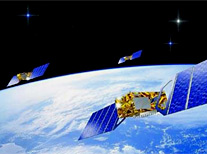
The 30-satellite system, which has a navigational fix accurate to within a meter, will provide safe, reliable and accurate navigational information for Chinese users in civil aviation, railways, waterways and road transport.
CASIC and its French peer are working jointly in China on an information retrieval system for the project.
Fang noted that China and France have enormous room for increased cooperation in such areas as satellite navigation. China offers a huge market for applications and France possesses advanced technology and extensive experience.
Sponsored by the European Commission and the European Space Agency, the Galileo project is a satellite positioning and navigation system to be used for civil purposes.
The project is scheduled to be operational by 2008, and is expected to outperform the existing Global Positioning System (GPS) of the United States with more precise information and wider coverage.
Vice-minister of Science and Technology Cheng Jinpei said at the forum that Chinese and French scientists have been working together since the two governments signed scientific cooperation agreements in 1978. In addition to aerospace projects, China hopes to increase its collaboration with France in agriculture, information technology, new energy resources and disease prevention and treatment.
The two countries are building joint laboratories for universities and research institutes to develop new technologies.
In its scientific blueprint for the next 15 years, China will concentrate on basic research and seek breakthroughs in energy and water resources, environmental protection, agricultural restructuring, manufacturing and others. It will also improve research facilities and place more emphasis on developing technological products that are competitive in the world market, said Cheng.
Philippe Guelluy, France's ambassador to China, noted that the two countries have worked together in IT and set up a research center at Tongji University in Shanghai. The center will offer specialized training programs from 2006.
The two-day China-France Science and Technology Innovation Forum is the largest science event scheduled during the ongoing French Culture Year in China. Some 300 representatives from the two countries are attending, China Central Television reported.
China and France signed a series of science cooperation agreements during French President Jacques Chirac's visit to China last month.
(China.org.cn, China Daily November 2, 2004)