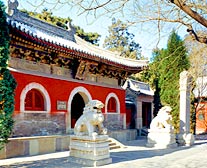
Jietai Temple, or temple of the ordination altar, is located 35 km (22 miles) west of Beijing. It takes its name from the famous Ming marble ordination altar. Built some 1,300 years ago, this altar is nearly 5 meters (16 feet) high and decorated with delicate, exquisite carvings.
Renovation on the Thousand-Buddha Pavilion, a major part of the Jietai Temple, will start this year. The geological survey has now finished and bidding work is under way. However, the whereabouts of Buddha statues, wooden frameworks and some historical documents such as architectural techniques relating to the pavilion is still unknown. The management staff of the pavilion have called on the whole country to bring back these Buddhas.
The Thousand-Buddha Pavilion was first built during the reign of Xianyong (1065-1074) of the Liao Dynasty, rebuilt in the 25th year of Jiajing reign (1546) of the Ming Dynasty and renovated to a large scale in the 31st year of the Guangxu reign (1905) of the Qing Dynasty.
The Thousand-Buddha Pavilion was 21 meters wide and measured 24 meters from entrance to rear. It was a wooden structure pavilion with a three-eaved roof. The pavilion went as high as 30 meters, in the center of which a bronze Buddha of Losana was worshipped. Brick walls on two sides were ornamented with a colored blaze. The pavilion had two stories, each of which contained 10 big niches, five on the left side and five on the right. Each big niche included 28 small niches, which were further divided into three smaller niches each. A 10-centimeter-high wooden Buddha was worshipped in each of these smallest niches. Altogether, they numbered 1,680.
Aged Beijing citizens preserve a custom of climbing mountains on the Double Ninth Festival, which falls on the 9th day of the 9th lunar month. The Thousand-Buddha Pavilion used to be a favorite destination of these climbers. Due to historical reasons, however, the pavilion has fallen into disrepair. What’s more, the subsidence of its northeast foundation has led to the slanting of its girders, which has caused further serious rain leakage. Therefore, the state decided to overhaul it on a large scale in 1965. However, shortly after the pavilion was dismantled, the “cultural revolution” started and renovation work had to be halted. All disassembled components and wooden Buddhas were lost.
It has become a great obstacle for the managers to restore the original appearance of the Thousand-Buddha Pavilion, especially to re-establish the 1,680 Buddhas and reset them to their exact positions, for now the existent materials about the pavilion only include a golden colored painting of a hundred-dragon niche drawn during the Ming Dynasty, three little Buddhas, photo of the look of its exterior and a few architectural materials.
What is encouraging is that Qin Baoyuan, who participated in dismantling the Thousand-Buddha Pavilion, has got in contact with the management department of the temple. Qin, now in his 70s, said that he, and another two engineers, spent more than a month measuring and registering details of each component of the pavilion during the dismantling. The thick book of archives, however, was later lost. If these materials can be found, the overall framework of the pavilion will become very clear.
Currently, the relevant departments hope to find complete documents about the Thousand-Buddha Pavilion so that they can start the restoration project as soon as possible. The Jietai Temple is part of the Western Beijing Temple Scenic Spot, which is one of six Beijing suburban sceneries included in the cultural relics protection program. The Beijing municipal government worked out the program to boost its cultural sense for 2008 Olympics.
(China.org.cn by Li Jinhui, February 7, 2004)