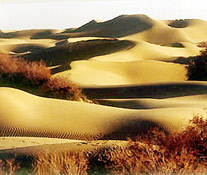
Despite the hard-won improvements in the environment in some parts of northwest China, deterioration is still an overall trend. Desertification, water shortages, low vegetation coverage and a sharp contradiction between human activities and land viability are the main factors marking the region, according to Ma Songyao, a researcher from the State Laboratory of the Cold and Arid Regions Environmental and Engineering Research Institute under the Chinese Academy of Sciences.
Desertification. Desert covers 2.6 million square kilometers of Chinese territory, and the figure is increasing at an annual rate of 2,460 square kilometers. In northwest China alone, the figure has reached 1.5 million square kilometers, accounting for 56.1 percent of the country's desert area. Severe soil erosion now affects 1.7 million square kilometers of northwest China, accounting for 57.0 percent of the region and 47.4 percent of the nation's total eroded land.
Water shortage. Long drought and human encroachment have overturned the ecological water balance in northwest China. Rivers are running dry, lakes are drying up and underground water levels are dropping. The area has low precipitation, quick water evaporation, frequent droughts and poor water reserves. While the region represents a third of the nation's land area, it has only a tenth of its water resources, with precipitation decreasing steadily from northeast to northwest. The area of Aibi Lake, the largest freshwater lake in the Xinjiang Uygur Autonomous Region, has fallen from 1,200 square kilometers in the 1950s to 500 square kilometers today. More than 30 percent of the lakes on the Qinghai-Tibet Plateau have become small saltwater inland seas, while many of those in the area of the Yellow River headwaters area have dried up. Drought and the shortage of water are the most obvious problems holding back sustainable development in northwest China.
Low vegetation coverage. Forested acreage stands at 2.3 million hectares, or 4.8 percent, far lower than the country's average of 13.0 percent. Forest and vegetation around the river sources are steadily withering, with little ability to conserve water and stabilize runoff. There are vast grasslands in the region, but 75 percent of their area has only sparse vegetation at best.
Human encroachment. The natural environment is extremely fragile in northwest China. Rapid population growth has resulted in excessive use of land resources, resulting in damage to vegetation and reduced soil fertility. The already-fragile environment is weakening.
Ma reports that their studies of the interaction between the environment and the economic and social development of northwest China have achieved preliminary results. The central government has issued policies on eco-agricultural construction in the desert and oases in northwest China, the loess plateau and the grasslands, as well as the mountainous regions of western Gansu Province and the irrigation areas along the Yellow River, where conditions vary widely.
(China.org.cn by Li Jingrong, April 21, 2004)