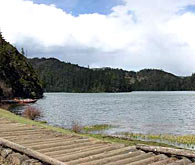
The ecological environment in areas inhabited by Tibetans in China has been well protected and is almost unchanged from last century, said Bob Moseley, an ecologist of the United States.
Moseley drew the conclusion after more than a year of first-hand research in the Diqing Tibet Autonomous Prefecture in Yunnan Province, southwest China.
In the eyes of an ecologist, Diqing was one of the most beautiful places in the world, said Moseley.
Based on his research, Moseley said that he found some places in the region had been covered by dense forest compared with the thin forest 80 years ago. Some barren land and hills had turned green, some villages had moved out of the forested area, and farmland had returned to forest.
Diqing is one of the 10 regions inhabited by Tibetans in China. It became known to the outside world in the novel, Lost Horizon, by British author James Hilton. Published in 1933, the novel described an "earthly paradise" which was called "Shangri-La". Many people believe that the legendary "Shangri-La" is located on the highland of Diqing.
However, some Western people, who are familiar with the legend, doubt whether "Shangri-La" remains as beautiful as it was in the past and believe its unique environment has been destroyed by human activity.
Moseley came to Diqing one year ago, sent by Nature Conservancy of the United States, to find an answer.
Moseley said that Hilton had never been to Diqing. The man who actually set foot on the Diqing highland was Austrian-American scientist J.F. Lock, who stayed there for 28 years until 1949. Lock, who was also a botanist and an explorer, tramped all mountains and valleys in the Diqing area and took many pictures.
Moseley said he wanted to travel on the same route that Lock took over 80 years ago and take pictures of today's Diqing, to find changes in the local environment by making a comparison between his pictures and that of the American scientist's.
Moseley selected over 200 pictures taken by Lock between 1921 and 1923. He chose the same places and same points of view to take his new pictures. He was very careful, and sometimes, he traveled for several days to reach the very places where Lock had taken pictures.
So far, Moseley has taken over 40 pictures and compared, one by one, his pictures and Lock's.
Moseley said that although he had not finished his study, he had found that changes in the ecological environment of Diqing were negligible compared with 80 years ago.
He claimed that the changes he discovered included: areas, formerly covered by thin forest, now covered by dense forest; former barren land now turned green; old villages moved out of the forested areas and farmland returned to forest.
Back in Moseley's home country, many people say that the ecological environment in areas inhabited by Tibetans in China has been severely destroyed and Tibetans are losing their beautiful homes and living environment.
But Moseley said that actually, "Shangri-La" had become more beautiful than it was in the 20th century, noting that it still had been one of the most sound ecological environments in the world.
(Xinhua News Agency June 18, 2002)