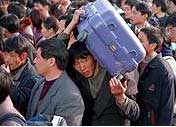
 The influx of surplus rural workers into cities has long become an issue in China. While making a great contribution to urban development, migrants also create potential problems. As the pros and cons continue to be debated, comprehensive channeling and management is seen as a good way forward.
In China's rural areas, the number of surplus laborers amounts to 130 million. Many have left the countryside to find work in cities and towns, resulting in 50 million migrant workers across the country. Over the past two decades, the general trend of rural labor migration has been progressive, according to a three-year-long survey made by the Institute of Rural Research under the Chinese Academy of Social Science.
As the survey shows, the targets of migration have changed. Higher pay has replaced job opportunity to become the primary goal for migration, tempting 53.56 percent of all migrant workers to flow into the cities. The third and the forth goals are new technologies and a change of environment. As the migration motives become multiple and complex, it can be predicted that the process will last for several more decades.
The 50 million migrant workers who live in the cities have made a great contribution to the development of these places, developing the urban economy and improving people's lives. In Beijing alone, migrant workers who have temporary residence registration permits amount to 1.6 million. In Shanghai, migrant workers account for 25 percent of the population.
The mobility of labor from agricultural to non-agricultural industries has made a contribution to China's economic growth as well as to an increase in the average income of rural people, as migrant workers send most of what they earn in urban areas back home.
However, this is only half the story. First, not all migrant workers are surplus labor in the rural area. Mostly between the ages 20 and 40, and having relatively high education, these productive citizens look for jobs in cities, leaving the elderly and young at home. This in turn gives rise to neglect of farmland and curtails the healthy development of rural areas.
Moreover, the migrant rural labor is also a great burden on the urban area, exerting strong impact on the urban social order. First, limited by their own education and the employment system in cities, most migrant workers used to do dangerous, dirty, tiring, or less-paid work rejected by city-dwellers. But as the state-owned enterprises continue to lay off workers, there is concern that a massive flow of labor to cities will intensify the competition for jobs there. During the past two years, many Beijing residents, now used to relying on migrant workers to perform household services ranging from cleaning to milk delivery, are recognizing the value of itinerant workers, instead.
Second, there is still a big discrepancy between urban-rural living standards and their own inferior positions damage the psychology of migrant workers, creating potential threat to social stability. Third, the influx of rural labor into cities burdens social welfare. Energy and transportation are among the items that are affected severely by this influx.
While the debate rages, comprehensive channeling and management are seen as being urgently needed. According to Zhang Xiaojian, director of the Vocational Training Department of the Ministry of Labor and Social Security, the 89 offices nationwide responsible for managing the transient population will report the number of migrant workers every month, so that rural workers will not leave for cities without any knowledge of job prospects.
As experts point out, township enterprises should be developed to absorb the rural labor surplus. The process of urbanization should be speeded up. When a township develops into a city, the labor-intensive tertiary sector will expand. This seems to be a way out for the labor surplus.
(CIIC by Gao Kun 03/01/2001)