More than a month after the devastating earthquake hit Sichuan and its neighboring areas, the affected regions are busy mapping out their reconstruction plans. But the World Bank experts warn that such plans must be made very carefully to avoid missing the target and incur frustration in the future.
They also suggested that a catastrophe risk insurance fund should be established to cater to future needs and community consultation must be thoroughly conducted to get the relocation process smooth.
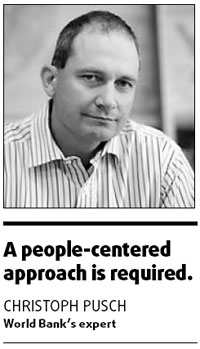
China has done a good job in the rescue and relief phase, said Christoph Pusch, the World Bank's South Asia regional coordinator for disaster risk management.
"What we've seen is outstanding" in terms of responsiveness, political leadership and public support, said Pusch, who was attending a World Bank workshop last Thursday brainstorming experiences on how to rebuild China's quake-affected areas.
"At the same time, having such great achievements also bears the risk of raising expectation that the next phase would be as smooth as the relief work," he said.
It is, therefore, very important to draft the reconstruction plan carefully and avoid major revisions at a later stage, said Pusch, citing a country where the political leader vowed after a major disaster to have everything reconstructed within one year, but where the reconstruction actually had taken five years. "Of course this created a lot of frustration."
The reconstruction process usually takes a long time. In Tangshan, Hebei province, which was hit by a 7.8-magnitude earthquake in 1976 that killed 240,000 people, it took 10 years for the reconstruction and resettlement to be completed.
More recent earthquake reconstruction programs in Turkey and India have been completed within four to eight years. Given the prolonged process, Pusch suggested the expectation of the public be properly managed through planning the time framework in a realistic way and making the process transparent to the people.
Based on experiences in other disaster-affected countries, "it's a good practice to have communities to get fully engaged in planning and implementing of the reconstruction programs," said Saroj Kumar Jha, the bank's program manager for the Global Facility for Disaster Reduction and Recovery (GFDRR).
Smooth and thorough communication between policymakers and the local disaster-affected public will have a long-term effect on the rebuilding process. "In the long term, what has really worked in any country is how much the community is involved in planning and designing and implementing the operations," said Jha. "The community will have to make a choice if it will move elsewhere. It works in the long term."
Agreed Pusch. In this way, "there is a greater chance of success in terms of achieving a harmonious and balanced construction program ... A people-centered approach is required."