Survey: Tibetan people satisfied with democratic reform
 0
0 


Most Tibetan people are satisfied with the Tibetan democratic reform that was carried out 50 years ago, according to a survey conducted by the China National Center for Tibetan Studies. Deputy Director of the center Gelek reported these findings on Tuesday at the second Beijing Forum on Human Rights.
 |
|
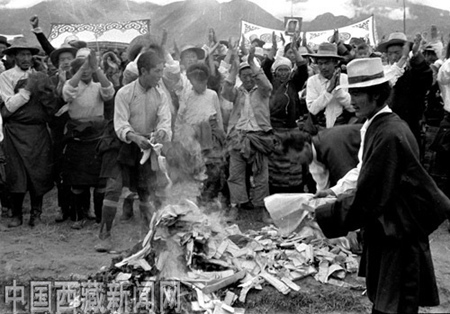
Photo shows the emancipated serfs burn land deeds to celebrate their freedom in 1959. [Tibet Daily/Tibet News Web] |
Launched in 1990, the survey aims to depict and reflect the changes of Tibetan society after its democratic reform. Gelek said the Tibetan democratic reform from 1959 to 1961 abolished the feudal serfdom system in Tibet, enabling a large number of serfs to possess their share of basic production resources, such as land and livestock. According to the statistics, by October 1960, land reform had been largely carried out in Tibet, with more than 186,000 hectares of farmland confiscated from serf-owners and allocated to some 800,000 landless serfs and slaves. More than 20,000 slaves were liberated in the crop-growing and pasturing areas.
In his report, Gelek noted that after the democratic reform, the majority of Tibetans were liberated out of the unreasonable system in which they were ruled by very few people. They became their own masters and had their destiny in their own hands. Their social positions have been unprecedentedly rising ever since. Anyone who is entitled to suffrage or who is eligible to run for election has been likely to do so. It is, no doubt, one of the greatest achievements in Tibet's political life.
 |
|
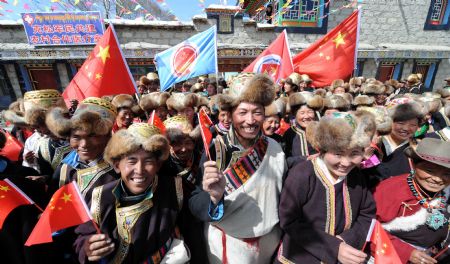
Local villagers celebrate to mark the 50th anniversary of the emancipation of millions of serfs and slaves in old Tibet at Kesum village of Nedong County, southwest China's Tibet Autonomous Region, March 23, 2009. [Xinhua] |
After the democratic reform, the economy in Tibet stepped into a new era, where people gradually enjoyed a harmonious life. The survey showed that Tibet's grain production has increased rapidly in crop-growing areas, and per capita livestock in pasturing areas now numbers nearly twice what it was before the reform.
All the facts above testify that the Tibetan democratic reform goes with the tide of history, and it was indeed a golden age for the social and economic development of Tibet, commented Gelek.


