Top legislator stresses CPC leadership
 0 Comment(s)
 Print
Print E-mail Xinhua, March 8, 2015


Top legislator Zhang Dejiang underscored Sunday the leadership of the Communist Party of China (CPC) in the work of the country's national legislature, while expressing confidence in the system of people's congresses.
 |
|
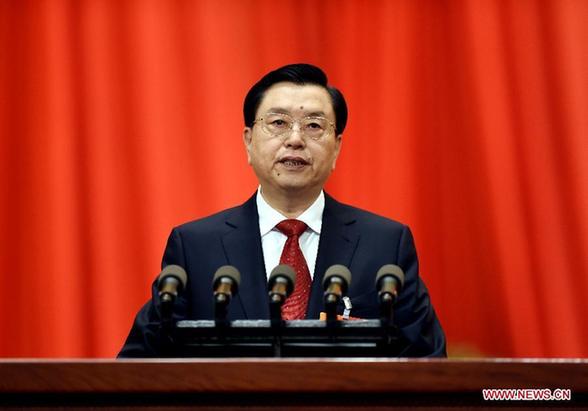
Zhang Dejiang, chairman of the Standing Committee of China's National People's Congress (NPC), delivers a work report of the NPC Standing Committee during the second plenary meeting of the third session of the 12th NPC at the Great Hall of the People in Beijing, capital of China, March 8, 2015. (Xinhua/Xie Huanchi) |
The CPC leadership is the most essential feature of socialism with Chinese characteristics, said Zhang, chairman of the Standing Committee of the National People's Congress (NPC), while delivering a work report at a plenary meeting of the top legislature's annual session.
"In adhering to and improving the system of people's congresses, we must unwaveringly uphold the Party's leadership and strengthen our confidence in the system," he said.
"We must improve the system on the basis of upholding the Party's leadership and develop it through practice to ensure it advances with the times," the top legislator added.
According to the Constitution, the 61-year-old people's congress system is the fundamental political system in China, which has about 2.6 million lawmakers at various levels, elected by respective constituencies, directly or indirectly.
Lawmakers are required to learn about the most pressing needs of the people as well as national urgencies. They push forward national and local policies through field studies, collecting public opinion and submitting motions and suggestions.
This framework is viewed as the precondition for "socialist democracy" that denies a system of multiple parties holding office in rotation or the Western-style "separation of powers."
Looking back on the NPC's Standing Committee work over the past year, Zhang said the top legislature had been upholding the Party's leadership throughout every process and aspect of the work.
"Upholding the Party's leadership over people's congresses is for ensuring that the Party can exercise leadership over the state and society through organs of political power," Zhang said.
He went on to cite a keynote speech made by Xi Jinping, general secretary of the CPC Central Committee, in commemoration of the 60th anniversary of the establishment of the NPC last year, saying that the people's congress system has provided a fundamental institutional arrangement for integrating leadership by the Party, the position of the people as masters of the country, and the law-based governance of the country.
It is also the fundamental political system underpinning China's governance system and capacity for governance, Zhang added.
Noting that China's system of people's congresses is fundamentally different from the West, Wang Changjiang, a researcher with the Party School of the CPC Central Committee, said the former has the advantage of ensuring people's position as masters of the country.
"Chinese lawmakers come from all walks of life and hence are the living embodiment of the will of the mass," Wang said. "That gives superiority to the people's congresses."
His words were echoed by Lin Yinmao, vice secretary-general of the Shanghai Municipal People's Congress Standing Committee, who noted that lawmakers have spearheaded and helped push forward reforms vital for the country in the face of the "new normal" of economic slowdown, via their legislation work.
According to Zhang Dejiang, Chinese lawmakers will speed up legislation to fight corruption, and will work to revise the law on air pollution prevention and control in 2015.
Lawmakers are also expected to review draft revisions to China's Legislation Law at the annual session, which bans ministries and local governments from issuing rules and policies that mitigate citizens' rights or increase their obligations without legal foundation.
Liang Ying, a member of the Legislative Affairs Commission of the NPC Standing Committee, meanwhile cast his eyes on a bigger picture.
He said the NPC could play an important role in the implementation of the strategic layout of "Four Comprehensives," which was elevated as a main theme of the ongoing annual parliamentary session.
The "Four Comprehensives," unveiled by Xi Jinping, refers to comprehensively building a moderately prosperous society, deepening reform, advancing the rule of law and strictly governing the Party.
"As the supreme organ of state power, the NPC could serve to push forward the implementation of the 'Four Comprehensives' by pooling wisdom and strength from the entire society," he said.


