A changing world order
 0 Comment(s)
 Print
Print E-mail Beijing Review, March 13, 2013


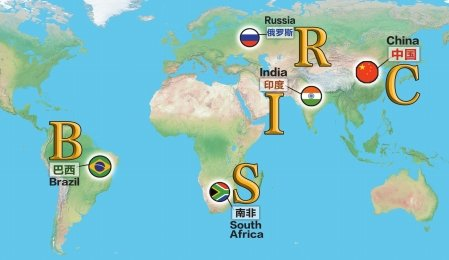
Some have suggested that because South Africa is the smallest of the BRICS nations in terms of population and GDP, it may not deserve a place in this club of leading developing nations. How do you respond to that?
The rationale for South Africa's consideration was a matter of crucial importance to BRICS Member States—namely the role of emerging economies in advancing the restructuring of the global political, economic and financial architecture into one that is more equitable, balanced and rests on multilateralism.
Those who constantly refer to this particular issue completely miss the point, namely, that BRICS is not all about size and numbers, but rather about ideas and ideology. BRICS is a response to the current global political and financial architectures, which are dominated by certain players. South Africa has a proven record of contributing to the discourse of multilateralism and advocating for the rights of emerging economies.
Among developing countries we are still the biggest investor on the African continent. This means that, although our economy is small in relation to other BRICS members, we have attributes that have positioned us well in the world and which will allow us to bring special insight to the work of BRICS.
As a member of BRICS, how can South Africa promote its own and other African countries' economic development and represent the interests of the African continent?
Our country, as a member of the Brazil, Russia, India, China and South Africa bloc (BRICS), is playing an important role in the shifting and distribution of international power. This shift is expected to give rise to a multi-polar world order.
Our interaction with fellow BRICS states is premised on three levels of engagement: firstly, national, where we advance our national interests. Secondly, regional, where we promote regional integration and interaction with specific emphasis on the African Union mandate to promote infrastructure development across the continent. And, thirdly, on a global level, where we advocate for a more inclusive global governance system.
What role do China and South Africa play in each other's development plans? What steps are South Africa taking to scale up its relationship with China?
The bilateral relationship between the two countries is grounded in the Comprehensive Strategic Partnership Agreement (CSPA) signed by our respective leaders in August 2010, which continues to guide interactions between South Africa and China. As partners, the two countries can learn from each other and develop the best possible models for addressing the issue of socio-economic development in our respective countries. In terms of bilateral trade, China has become South Africa's largest trade partner. Both sides are looking at ways of encouraging further trade, but are also concentrating on the quality of trade rather than the quantity. We enjoy cooperation in numerous fields and, as a reflection of the growing ties between the two countries, in July 2012 our leaders proposed the establishment of a joint work group to coordinate the implementation of various bilateral projects.
Xavier Carim, Deputy Director General at the SA Department of Trade and Industry, has said that South Africa wants to align its interests to support the integration agenda in Africa, rather than just focusing on access to resources. What does this mean to you?
Trade between our countries is skewed in favor of China, and so South Africa is running a trade deficit with China. Through discussions with the Chinese Ministry of Commerce, South Africa and China have agreed to promote value-added exports from South Africa to China in order to lower the trade deficit and diversify trade away from primary commodities to include more manufactured goods.
In this light, South Africa will certainly be measuring future successes in trade relations by evaluating the reduction in the trade deficit and the increases in value-added exports from South Africa to China. The Department of Trade and Industry of South Africa, in partnership with the Chinese Ministry of Commerce, also jointly host what are known as the South Africa Expos in China, the last of which was held last year in both Beijing and Shanghai. The purpose of the Expos is to expose Chinese buyers to a different range of South African exporters in various fields, including agro-processing, manufacturing, engineering, jewelry and many others. We are confident that as these Expos become widely known, the opportunities for sustainable partnerships between the business communities of the two countries will be expanded, thus leading to a more equal trading relationship.


