China vigilant against quantitative easing in developed economies
 0 Comment(s)
 Print
Print E-mail Xinhua, March 7, 2013


China's political advisors expressed concerns about the impact of quantitative easing policies in developed countries, urging the nation to speed up industrial restructuring to tackle related challenges.
 |
|
|
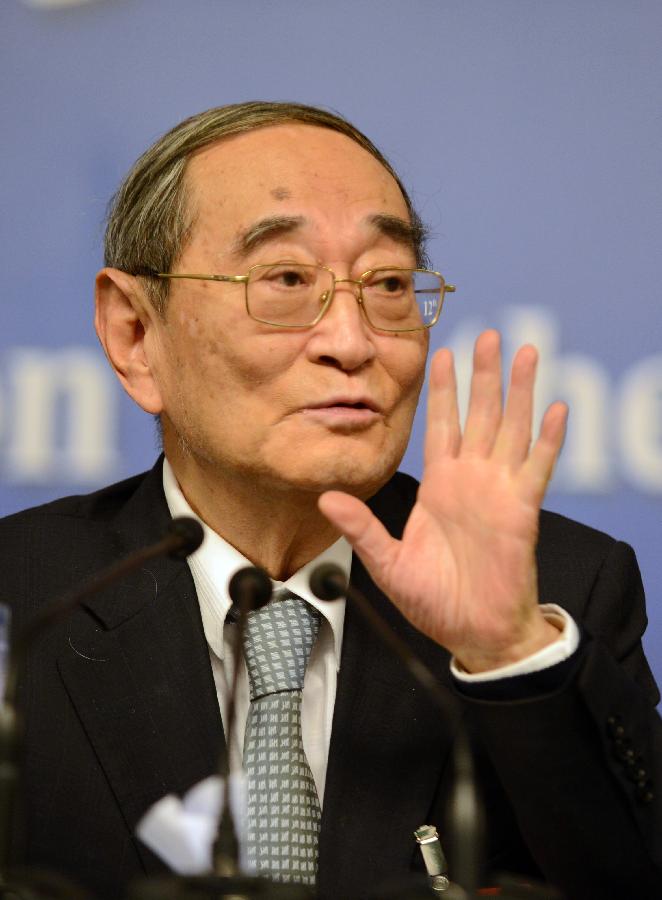
Li Yi'ning, a member of the 12th National Committee of the Chinese People's Political Consultative Conference (CPPCC), speaks at the press conference held by the first session of the 12th CPPCC National Committee in Beijing, capital of China, March 7, 2013. |
"We don't agree with the excessive monetary easing used in some countries," said economist Li Yining at a press conference held on the sidelines of the annual ongoing session of China's top political advisory body.
The political advisors' renewed call for restraint in monetary easing has highlighted the pressure that has hit emerging economies, particularly those in the Asia-Pacific region.
Apart from a new round of quantitative easing launched by the U.S. Federal Reserve last year, the Japanese yen has depreciated more than 15 percent against the U.S. dollar over the past two months due to an expansionary policy implemented by Japanese Prime Minister Shinzo Abe.
While delivering his last government work report at the parliament's annual session on Tuesday, Premier Wen Jiabao said China will maintain a proactive fiscal policy and a prudent monetary policy in 2013, as well as secure economic growth of 7.5 percent and keep inflation around 3.5 percent.
As a sign of increasing capital inflow amid China's improved economic prospects, Chinese financial institutions saw their yuan funds outstanding for foreign exchange increase by 683.7 billion yuan (108.9 billion U.S. dollars) in January, the highest monthly increase on record, data from the central bank showed.
Since capital accounts are tightly controlled by the government, China's central bank and commercial banks have to buy large quantities of foreign exchange to stabilize the yuan's exchange rate, resulting in loose liquidity in the domestic market.
Justin Yifu Lin, former vice president and chief economist of the World Bank, said he expects China's currency to continue appreciating this year thanks to globally loose liquidity.
"Policymakers need to make appropriate adjustments according to China's domestic productivity and the balance of international payments," Lin said in a group interview held during a press conference.
Lin is also a member of the National Committee of the Chinese People's Political Consultative Conference (CPPCC), the country's top political advisory body.
"I think it's important for China to adopt a relatively proactive fiscal policy while keeping its monetary policy moderate, as this will be helpful to maintain rapid economic growth and keep prices relatively low," Lin said.
If China sees a massive inflow of short-term speculative funds, the country can take necessary capital-control measures to prevent drastic appreciation for the yuan and avoid bubbles in the property sector and equity markets, Lin said.


