Investment access set to widen
 0 Comment(s)
 Print
Print E-mail China Daily, March 12, 2012


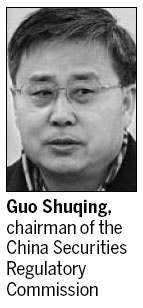
The mainland might launch a program to allow Taiwan investors to use offshore yuan deposits to invest in the mainland's capital markets, Guo Shuqing, chairman of the China Securities Regulatory Commission, said on Sunday.
A similar program, known as the RMB Qualified Foreign Institutional Investor, or RQFII, was launched in Hong Kong at the end of last year with a quota of 20 billion yuan ($3.17 billion).
At present, individual investors in Taiwan can directly invest in the mainland's dollar-denominated B-share market. They can also buy yuan-denominated A shares through the QFII program.
"We are likely to launch the RQFII program in Taiwan in the future, as well as allowing individual investors in the region to invest directly in the A-share market," Guo said on the sidelines of the two sessions. But he added that study of the issue hadn't yet started.
The program offers more investment channels for the growing amount of yuan deposits in Hong Kong, which reached 576 billion yuan at the end of January.
Under the program, Hong Kong institutional investors can invest in the A-share market using yuan parked overseas.
Taiwan said last year it also wanted to be a trading center for offshore yuan, aiming to take advantage of the yuan's internationalization.
In August 2011, Taiwan's "central bank" listed "being an offshore yuan center" as one of its long-term targets.
A month later, the Taiwan Financial Supervisory Commission, the region's financial regulator, awarded its first license for the region's banks to conduct yuan-related business, including currency conversion, trade finance and remittances.
The license was given to HSBC Holdings' Taiwan subsidiary. The Bank of East Asia Ltd got the same kind of license a month later.
Some financial institutions in Taiwan have already been granted quotas under the QFII program, which allows investors outside the mainland to invest in the mainland's capital markets using US dollars.
In August, regulators in Taiwan gave the go-ahead for local QFII candidates to invest in the mainland's A-share market, opening that market to Taiwan institutional investors for the first time.
Wang Jianhui, chief economist with Southwest Securities Co, said that the RQFII program in Taiwan wouldn't start for at least five years.
"Even in Hong Kong the program has been very much sought-after. So the timing for Taiwan, where there is a much smaller amount of yuan deposits, is far from ripe," he said. "A lot of work must be done before the program can be launched."
It is "possible" in the future to allow individual investors in Taiwan to invest directly in the mainland's A-share market, Guo said.
Individual investors in Taiwan now only have direct access to the mainland's dollar-denominated B-share market.
Taiwan investors' interest in the mainland's capital market boomed in recent years.
With no direct link to the A-share market, many individual investors in Taiwan use the accounts of mainland friends and relatives to make investments, which lead to disputes.


