Qian Xuesen: Father of China's space program
- By Li Zheng
 0 Comment(s)
 Print
Print E-mail
China.org.cn, July 22, 2011
E-mail
China.org.cn, July 22, 2011


Qian Xuesen, a gifted rocket scientist who led China's space and rocketry programs, was born in Shanghai in December 1911.
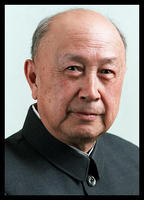 Enrolled in Shanghai Jiao Tong University in 1929, Qian observed China's aerial inferiority and decided to revitalize the nation, changing his major to study aircraft manufacturing.
In 1934, Qian won a scholarship and with which in September 1935 he left China to study at the Massachusetts Institute of Technology.
Two years later, he went to the California Institute of Technology to commence graduate aviation studies under mentor Theodore von Carmen, a world-famous professor of aerodynamics. Qian obtained a master's degree in aerospace engineering and doctorates in aviation studies and mathematics.
From 1938 to 1955, Qian stayed in America, working with Carmen to research aerodynamics, solid mechanics, rocketry and missiles. The 28-year old Chinese student's work established him as one of the world's leading aerodynamicists.
Despite his high salary and comfortable life in the U.S., Qian remained concerned about his home country's development. In October 1955, Qian braved all the difficulties and finally made his way back to Chinese mainland.
Immediately upon his arrival, Qian Xuesen, together with dynamics expert Qian Weichang, established the Institute of Mechanics and took a post as its director. Thereafter, Qian set out to pioneer China's missile and rocketry programs.
In 1956, Qian submitted a proposal to the Chinese government to establish the nation's aerospace defense industry. Beijing took his suggestion, setting up the Aviation Industry Committee. That same year, Qian was also appointed the director of China's first research institute of rocketry and missiles.
Qian won high praise at home and abroad. He was a member of the Chinese Academy of Sciences. The Chinese government named him an "Outstanding Scientist of the Nation" and awarded him the "Meritorious Medal of Two Bombs and One Satellite" for his work on the country's first ballistic missiles, its first satellite and the Silkworm anti-ship missile.
Uninterested in fortune and fame, Qian devoted his life to rebuilding the nation. "As a Chinese technician, my life's purpose is to serve the people," he said. "If after I die the public feels I have made some contribution during my life, that approval would be the highest praise of all."
Qian died on Oct. 31, 2009. The Chinese people will never forget his contribution.


