China to adopt tougher rules on organ donors
 0 Comment(s)
 Print
Print E-mail
China Daily, November 7, 2011
E-mail
China Daily, November 7, 2011


 |
|
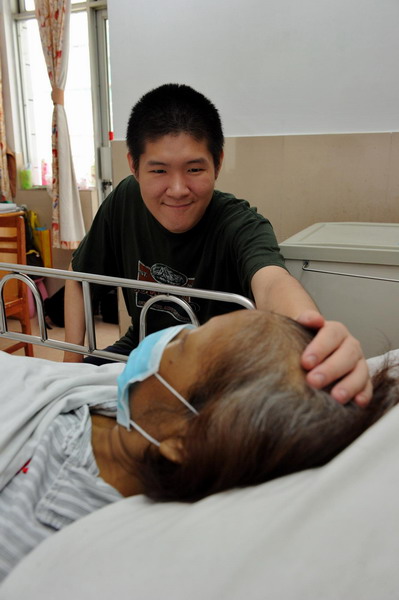
Peng Si caresses his mother's head at a hospital in Guangzhou, South China's Guangdong province on Sep 10, 2011. The 22-year-old son returned to Guangzhou from studying in the US to donate part of his liver to his mother, who was suffering from fulminant hepatitis. With 60 percent of his liver transplanted during a successful operation, he has saved his mother's life. |
China intends to further regulate organ donations to deter the illegal trade in living organs, according to the Ministry of Health.
Under the current regulation, "the recipient of a living organ must be the donor's spouse, lineal descent or collateral relative by blood within three generations, or they must prove they have developed a family-like relation with the donor", a clause which has been exploited by some hospitals, doctors and illegal agencies that supply organs from strangers willing to donate for money under a false identity.
"That clause will be removed from the current regulation," said an official with the department of medical service supervision under the Ministry of Health, who would only state her surname of Wang, at a forum held by the ministry over the weekend.
The relationship clauses for donors will be more clearly defined and detailed after the revision, said Shi Bingyi, vice-chairman of the Chinese Transplant Society.
It is not known yet when new regulation will come into force.
Living organ donations, which can cause health risks for the donor, should always be the last resort when no suitable organ from a deceased donor is available, said Chen Shi, an organ transplant expert with the institute of transplantation at Shanghai-based Tongji Hospital.
"In the worst-case scenario, which we've seen happen, both the living donor and the recipient die," warned Huang Jiefu, deputy minister of health.
According to Huang, living organ transplants peaked around 2008 when they accounted for more than 40 percent of the total number of transplants on the mainland.
China banned the trade in illegal organs when it introduced the regulation on human organ transplants in 2007 to ensure the industry's healthy and sustainable development.
Seven hospitals have since been disqualified and eight doctors had their licenses revoked for organ transplant violations, according to Huang.
Currently, about 1.5 million Chinese need a life-saving organ transplant, but there are only 10,000 organs.
To facilitate and encourage people to donate their organs after they die, the ministry and the Red Cross Society of China (RCSC) co-launched a nationwide human organ donation and allocation system for transplants last March.
Statistics from the RCSC showed that by the end of October, 128 people had donated organs after their death via the system, enabling more than 320 transplants.


