Sichuan 3 years later: Wenchuan, Dujiangyan, and Pengzhou
- By Corey Cooper
 0 Comment(s)
 Print
Print E-mail
China.org.cn, May 26, 2011
E-mail
China.org.cn, May 26, 2011


|
Editor's Note: On May 16-19, a group of journalists from china.org.cn and other publications travelled to towns and villages in Beichuan and Wenchuan counties as well as other municipalities hit hardest by the May 12, 2008 Sichuan earthquake, to examine reconstruction efforts and gain a better perspective of life in the quake zone three years later. The following article is part three in a three-part series. Don't miss: Sichuan 3 years later: The promise of a new future |
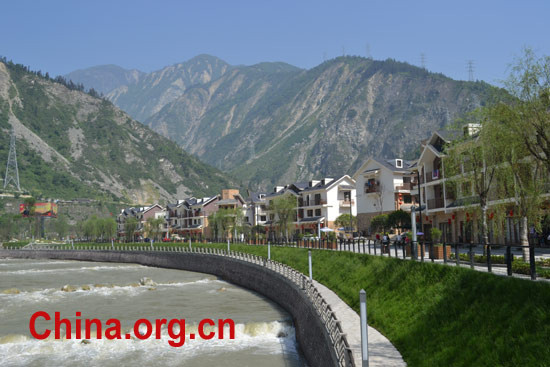
To compensate for the loss of industry, many areas we toured in the 5.12.08 earthquake zone have sought to gain new fortune in tourism. This was the most evident on the third day of our tour, when we visited the towns of Yingxiu and Shuimo in Wenchuan County.
 |
|
Reconstructed homes in Yingxiu City, Wenchuan County. [Photo: Corey Cooper / China.org.cn] |
Shuimo was by far the most impressive example of the "economic shift" from heavy industry to tourism following the reconstruction process. As our tour guide explained, Shuimo used to be one of the most heavily polluted areas in the region, its air clogged by production from numerous steel and metal production factories. Now, the air shined a brilliant blue as Shuimo took on its new face as the heart of culture and tourism in Wenchuan County.
To reconstruct Shuimo's historic Old Town, previously a source of tourism income, planners created three separate architectural districts reflecting the diverse culture of the Aba Autonomous Region: Tibetan, Qiang and Han Chinese. But it's not only the architecture that's stunning. With traffic of nearly 20,000 tourists a day, retail life has exploded, with a fast array of shops, tea houses, restaurants and hotels. The town's community life is completed with the beautiful new Wenchuan no. 81 Elementary school, Tibetan and Qiang cultural centers, and old-age recreation facilities. Walking through the old town, the restaurants were filled, and the clack of Mah-Jongg tiles could be heard from tea houses and other buildings nearby. The town's spiritual energy, clearly, had returned.
On the last day of our trip, we witnessed a final testament to the region's extreme motivation to promote tourism to replace its lost industry: Bailu Town in the Pengzhou City vicinity. In addition to a sobering earthquake museum that included an "earthquake experience" simulator, we toured the ambitious "Loire Castle" development area designed to look like a quaint early modern French village. Gaining advice from design firms in Chengdu and Beijing who had studied classic European architecture, the city's designers constructed a fantasy domain of brightly colored townhouses, complete with romantic hotels and a wedding chapel. We even had decent coffee in a quaint little shop resembling a Parisian inn. The project, the town officials explained, had received input from the French consulate in Chengdu and had also held events promoting Sino-French exchange.
Although the Loire Castle area had just opened less than a month ago, for town officials, the sky was the limit in terms of its tourism potential.
"We wanted to create something unique for the area. If we created another 'old-Chinese'-style town, we wouldn't get nearly the same tourism traffic," one official explained. He said that the town's expectations as a wedding and honeymoon destination for people around the area and beyond were high.
"We're expecting a huge turnout next Valentine's Day," he said.
Looking back, one of the most touching experiences of the trip was our tour of the Dujiangyan dam Scenic Area on day three. Although the dam itself only incurred minor damage, the nearby Two Kings Temple was devastated. As of our trip, about 85 percent of the temple had been restored, with close attention to detail taken to preserve its historic significance. Teams of workers were busy rebuilding one of the temple building's facades, brick by brick.
Built in 256 B.C. during the Warring States Period, the Dujiangyan dam's resistance to the earthquake's destruction seemed to resemble the remarkable resilience of the Sichuan people. With the help of their fellow countrymen, they refused to be consumed by adversity, and have gone on in rebuilding their lives.
As was reiterated by Wang Xiaohui, Vice President of China.org.cn who joined me on this eye-opening four day tour, "Providing adequate housing for displaced residents was the government's most important responsibility in the reconstruction. Housing plays an integral part of providing hope to the residents. If they don't have a decent place to live, how can they go on with their lives? It's part of giving people hope."
Given this glimmer of hope and a fresh start, the surviving residents of Wenchuan, Beichuan, and other cities and counties in Sichuan Province have adapted to their new surroundings. Many who lost children have had new ones and are rebuilding their families once again. And in some areas, the change from industry to tourism has indeed proven prosperous. Not all residents will be better off economically than they were before. But at least, thanks to the country's steadfast efforts, they will have a chance for a better life.


