Leadership takes pride in legal system
 0
0 


China has established a comprehensive socialist legal system that provides a legal basis to help with the development of almost all sectors of the country, top legislator Wu Bangguo announced on Monday in Beijing.
|
|
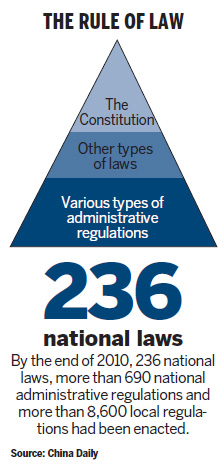
The system, with the Constitution as its head, Constitution-related laws, civil laws, commercial laws and other important laws as its backbone, and national and local regulations as its support, is in accordance with China's present circumstances and is a good basis to ensure the continuation of a socialist system that remains Chinese in nature, Wu said.
By the end of 2010, 236 national laws, more than 690 national administrative regulations and more than 8,600 local regulations had been enacted, according to the National People's Congress (NPC), the country's top legislature.
"The system ensures that our country will follow the right socialistic direction in future development," said Wu, chairman of the NPC Standing Committee. "And, by providing a legal basis and guide for values, it also solves the essential, comprehensive and long-term problems encountered by our country."
The establishment of the system dates back to the first generation of leadership within the Communist Party of China, which "laid the political premises and the systematic foundation", Wu said.
In 1954, the NPC held its first session and unanimously approved the first Constitution of the People's Republic of China, which was subsequently called the "1954 Constitution". It established the basic structure of the government and guaranteed a relatively comprehensive set of human rights.
Since the late 1970s, the Party and national leadership, headed by Deng Xiaoping, shifted the country's priorities to economic development. Deng said socialist democracy should be ensured by "institutionalization and legalization", preventing it from being changed at the whim of future leaders.
The next generation of leadership, headed by former president Jiang Zemin, enriched and developed the socialist legal system and, for the first time, deemed the rule of law to be a general principle for the State. It also set a goal of having the socialist legal system of China established by 2010.
The current leadership, headed by Hu Jintao, put the idea of the rule of law into practice, placing emphasis on the "leadership of the Party and the rule of the people" as the basis of socialist democratic politics.
Upon completing the comprehensive socialist legal system after decades of work, Wu encouraged lawmakers to continue striving at their appointed tasks and, at the same time, to pay more attention to the revision and improvement of existing laws.
"We should put even more efforts into legislation, since our legal system is not perfect yet," Wu said. "It is not static or closed to change, but should constitute a long-term procedure for the improvement needed to adapt to new social situations."
Wu also urged lawmakers to find ways to let the public take part in the nation's legislative processes.
Lawmakers should be cautious, perform research and reach a comprehensive consensus before submitting draft laws that lead to debate, he said.
Chen Sixi, a member of the NPC Standing Committee and deputy director of the NPC Committee for Internal and Judicial Affairs, said the legal system should still undergo improvement.
Wu emphasized that law enforcement is essential to the legal system,
"We should come up with measures to ensure the implementation of the Constitution and other laws, to safeguard the law's authority and dignity, and also to maintain justice," he said.


