Shantytowns face hard home truths
 0
0 


Residents in Hong Kong brace for uncertain future as development looms.
Lily Tse's dilapidated hillside home is in the middle of a labyrinth of straggling shacks rigged with corrugated metal, wooden planks and other scrap materials.
 |
|
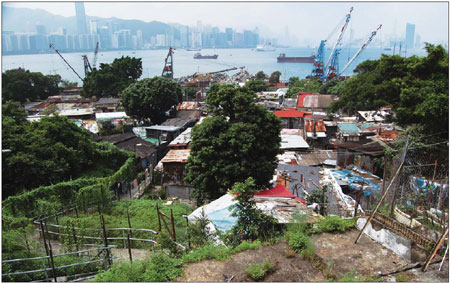
Cha Kwo Ling, one of the shantytowns in Hong Kong, overlooks the iconic Victoria Harbour. There are a total of 393,000 shanty structures in the SAR, most in the northern New Territories. |
Here, roofs are often just thick tarps weighted down with bricks, while electrical wires dangle overhead, tangling outside homes with television cables and clotheslines.
Even the most detailed map of Hong Kong does not clearly trace the boundaries of Cha Kwo Ling in eastern Kowloon. Not because many of its houses are too small and scattered, but because its haphazard sprawl is almost impossible to delineate.
"My house could have stood for a hundred years. I'm not sure how much longer it will last, though," said 65-year-old Tse, one of about 3,000 people who still live in this village, flanked by glitzy skyscrapers.
Talk of redevelopment has circulated for several years, yet for many residents the future remains far from certain.
Although demolishing the village could help some escape the rough and unsanitary conditions, others could potentially be left homeless.
There are 393,000 shanty structures throughout Hong Kong, more than 85,000 of which are used as homes, according to the Special Administrative Region's (SAR) development bureau.
Under local law, the buildings are technically illegal. As they are neither private properties nor public housing, they are given special dispensation from the government to remain.
"The formal name is 'tolerated structure' but I give them another name: zinc-clad structure," said Kenneth Ip, 63, an amateur historian who grew up close to Cha Kwo Ling.
Tse runs a tiny cafe on the ground floor of her gable-roofed stone house, living with her husband in the attic above.
The building could date back to the early days of colonial rule, but all she knows for sure is that her father-in-law at some point managed to acquire it and open a cafe, which she took over in the 1980s.
The shantytown, which overlooks the iconic Victoria Harbour, sits between two busy subway stations and adjoins a vast estate of high-rise apartment blocks.
The area has long been a major settlement of the Hakka ethnic group, who established a quarry in the stone-rich area a century ago. Makeshift shacks started to mushroom in the 1940s, as refugees streamed in from the Chinese mainland to escape the civil war. At its peak in the 1960s and 1970s, the community was home to more than 10,000 migrants.
Although the number of residents began to shrink in the 1980s, the shanties stayed standing. Plans to raze the area and build a new residential community have so far come to naught, although any such development could be a double-edged sword for residents.
As Tse's house is technically illegal, she and her husband are unlikely to receive any compensation from the government if officials chose to demolish it. The only benefit would be getting "priority status" for public rental housing, which would significantly cut the waiting time.


