Expert: Half of China's antibiotics fed to animals
 0
0 


Nearly half of the antibiotics produced in China are being fed to livestock rather than used to fight viruses in people, experts say.
 |
|
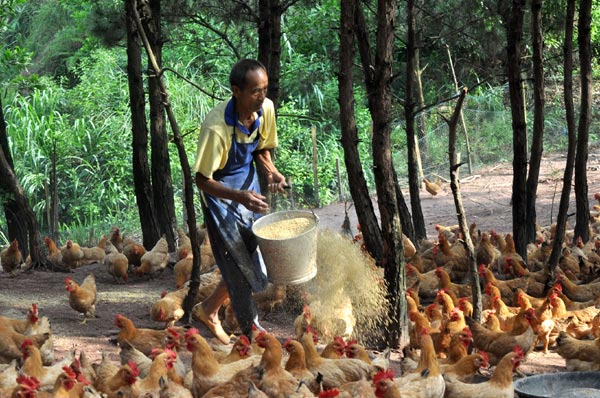
A farmer feeds his chickens in Dahua village of Rongxian county in the Guangxi Zhuang autonomous region on June 29. |
Of the 210,000 tons of antibiotics made in China each year, 97,000 tons end up in animals, Xiao Yonghong, a professor from the Institute of Clinical Pharmacology of Peking University, was quoted as saying by People's Daily.
Research by the Chinese Academy of Social Sciences found that more than 50 percent of livestock breeders in Shandong and Liaoning provinces added antibiotics to their animal fodder.
"The overuse of antibiotics is common now, which has led to a rising death rate among animals as their immune systems are depressed. Also, antibiotics remain detrimental to people's health after intake," said Qi Guanghai, deputy head of the feed research institute under the Chinese Academy of Agricultural Sciences.
"Attention should be paid to the problem of antibiotic intake via daily food consumption because that will increase the possibility for drug-resistant bacteria to develop in human bodies," said Huang Liuyu, director of the Institute for Disease Prevention and Control of the People's Liberation Army.
For example, a 650-gram premature infant born in Guangzhou developed resistance to seven kinds of antibiotics, which was suspected to be due to his mother's daily intake of meat and eggs that contained remnants of antibiotics, the People's Daily report said.
Last month, the Chinese mainland reported its first cases of the new NDM-1 superbug, which is resistant to nearly all antibiotics.
Given rising drug resistance cases detected in China and the world, Huang said authorities should pay more attention to the problem and regulate the sector.
"In Europe, antibiotics have been banned from being added to fodder for many years and a similar ban will be implemented in South Korea next year," said Tu Yan, a researcher from the Chinese Academy of Agricultural Sciences.
"For China, it's not practical to ban the use of antibiotics in the breeding industry now as animals are facing serious threats of diseases due to limited sanitary conditions. But more research on substitutes for antibiotics in the breeding industry is under way now," she said.
China introduced antibiotics into its breeding industry for their outstanding effect on preventing diseases in the 1990s.
The country's current regulation on medical additives in fodder was issued in 2002, primarily focusing on guidelines for the proper doses of different antibiotics added to fodder.
It does not address supervision on the sale and overuse of antibiotics.


