l????????
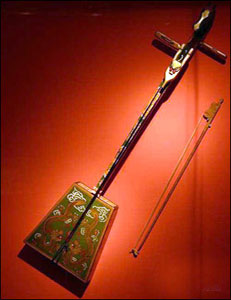
Morin Khuur (string instrument - horse-head-violin)
The morin khuur is a typical Mongolian two-stringed instrument. The
body and the neck are carved from wood. The end of the neck has the
form of a horse-head and the sound is similar to that of a violin
or a cello. The strings are made of dried deer or mountain sheep
sinews. It is played with a bow made of willow, stringed with
horsetail hair and coated with larch or cedar wood resin.
This instrument is used to play polyphonic melodies, because
with one stroke of the bow the melody and drone-strings can be
played at the same time. The morin khuur is the most widespread
instrument in Mongolia, and is played during celebrations, rituals
and many other occasions, as well as an accompaniment for dances or
songs. Even the sound and noises of a horse herd are imitated on
the morin khuur.
People say that it is connected with a handsome man. It is also
played when a ewe doesn't want to suckle her lamb. It is believed
that the ewe, hearing this music, will feel better and accept her
lamb.
l????????
Khuuchir (string instrument)
Formerly, the nomads (called "the savages") mainly used
the snake
skin violin or horsetail violin. The Chinese call it "the Mongol
instrument" or "Huk'in." It is tuned in the interval of a fifth and
is small or middle sized.
The khuuchir has a small, cylindrical, square or cup-like
resonator made of bamboo, wood or copper, covered with a snake skin
and open at the bottom. The neck is inserted in the body of the
instrument. It usually has four silk strings, of which the first
and the third are accorded in unison, whereas the second and fourth
are tuned in the upper fifth. The bow is coated with horsetail hair
and inseparably interlaced with the string-pairs; in Chinese this
is called "sihu," that is "four," also meaning, "having four ears."
The smaller instruments have only two strings and are called
"erh'hu," that is "two" in Chinese.
l????????
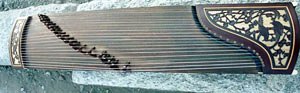
Yatga
The yatga is a half-tube zither with a movable bridge. It is
constructed as a box with a convex surface and an end bent towards
the ground. The strings are plucked and the sound is very smooth.
The instrument was considered to be sacrosanct and playing it was a
rite, bound to taboos. The instrument was mainly used at court and
in monasteries, since strings symbolized the twelve levels of the
palace hierarchy.
Shepherds were forbidden to play the twelve-stringed zither, but
they were allowed to play the ten-stringed zither, which was also
used for interludes during recitations of epics.
Mongolians traditionally play three types of this zither,
differentiated by their resonators or hollow bodies in which the
sound is amplified. Designs include the master yatga; ikh gariing
yatga, the national yatga; akhun ikh yatga, and the harp, called
the bosoo yatga.