
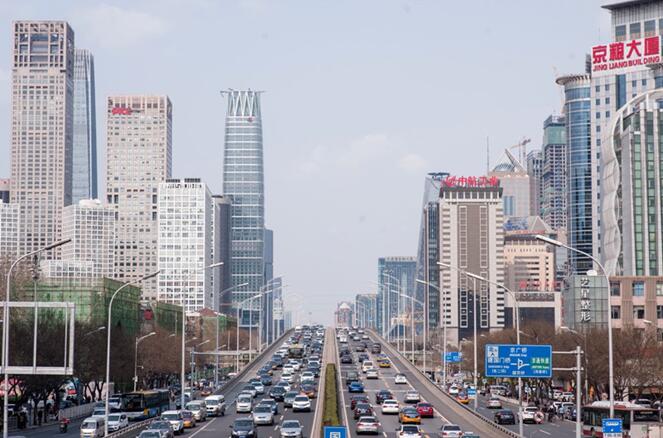
Spurred by its policy of reform and opening up, China has experienced the largest and most rapid urbanization in human history; in 30 years China's urbanization rate rose from less than 20 percent to over 58 percent.
Its development, however, is unbalanced, said Li Tie, chairman and chief economist of the China Center for Urban Development, speaking at the 2018 Boao Forum for Asia (BFA) on Apr. 10.
With their sophisticated infrastructure and concentrated access to education, healthcare and other opportunities, megacities are attracting more people to work and stay, causing urban woes like pollution, over-crowdedness, runaway property prices and traffic congestion. At the same time, medium-sized and smaller towns face the conundrum of attracting talent, industry and investment.
"Based on overseas experiences, urban diseases appear at a certain stage of urbanization," Li noted. "And this prompts relatively small towns nearby to help relieve them."
City clustering
According to the report delivered by Xi Jinping, general secretary of the Communist Party of China (CPC) Central Committee, to the 19th CPC National Congress, China will create networks of cities and towns based on city clusters, enabling the coordinated development of cities of different sizes, and small towns, and speed up work on granting permanent urban residency to people who move from rural to urban areas.
Specifically, the report urged the government to drive the coordinated development of the Beijing-Tianjin-Hebei region, develop forward-looking plans and adopt high standards for building the Xiongan New Area. Furthermore, the development of the Yangtze Economic Belt will be facilitated by promoting well-coordinated environmental conservation and avoiding excessive development.
Building satellite cities around megacities may be the solution for another round of regional economic success and to keep runaway property prices on hold, said Mo Tianquan, a member of 13th National Committee of the Chinese People's Political Consultative Conference (CPPCC) and chairman of Fang Holdings Ltd.
Mo told China.org.cn that city clusters will promote the reallocation of resources, break down the limits of administrative boundaries and shift non-essential functions of big cities to smaller cities, thus providing new opportunities to nearby regions.
It is estimated that 67 percent of the U.S. GDP comes from city clusters around New York, Los Angeles and the Great Lakes region, while similarly Japan's three major clusters account for 65 percent of the country's total population and 70 percent of its GDP.
Tapping the potential of smaller towns
Compared with city clusters in other countries, Chinese metropolises offer equally good infrastructure and public services, but its medium-sized and small towns are still outdone by their overseas counterparts.
Unlike the bigger cities, small towns in China suffer from an imbalance in economic development due to shortages in capital, technology and skills, which renders them less attractive in terms of resources and talent for innovation, said Zhang Shufeng,executive president of China Fortune Land Development Co. Ltd (CFLD), the country's industrial zone developer and operator.
The company has championed the public-private partnership (PPP) model in building new industry cities in small towns surrounding large metropolises and encouraging investment to make development more sustainable.
From city planning, infrastructure and public facility development, to administration of city operations and solicitation of investors, CFLD partners up with local governments to make small towns more attractive to potential job candidates.
In recent years, brain drain and fierce competition for fresh graduates have led relatively small cities to offer increasingly generous policies to attract and retain talent.
Though the policies vary from city to city, they generally focus on the major challenges facing graduates, including preferential treatment for permanent residence (called hukou in Chinese), housing and government subsidies.
To truly accomplish a "brain gain," cities must find and exploit their own competitive advantages, said Lu Ming, a professor at Shanghai Jiaotong University.
In the meantime, said Li Tie, the greatest advantage for cities to retain their workforce is not just providing housing or offering permanent resident permits. "The most enticing offers for talents have always been desirable job opportunities and good future development."
From the development of tourism to the exploration of new industries, relatively small towns still have much to do in order to fully tap their potential, Li concluded.