Xi warns against chaos in region
 0 Comment(s)
 Print
Print E-mail China Daily, April 8, 2013


No country should be allowed to damage world peace or throw a region into chaos for selfish gains, President Xi Jinping said on Sunday.
The remark shows China's determination to maintain regional peace as tensions in northeastern Asia run high, analysts said.
 |
|
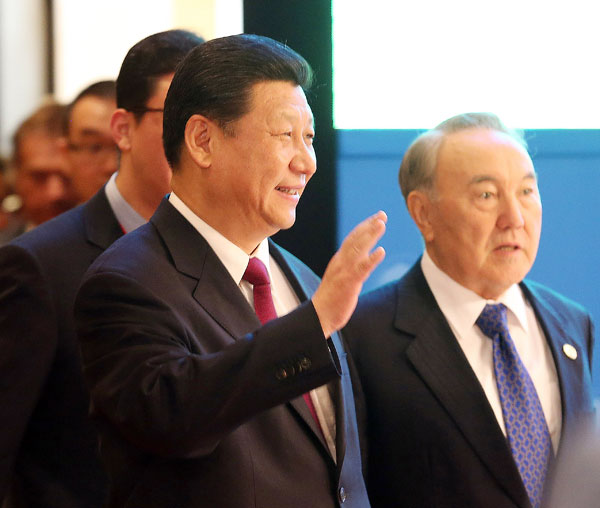
President Xi Jinping arrives at the Boao Forum for Asia Annual Conference 2013 in Boao, Hainan province, on Sunday. [China Daily] |
"Countries - big or small, strong or weak, rich or poor - should all contribute their share in maintaining and enhancing peace," Xi said at the Boao Forum for Asia Annual Conference 2013, which attracted more than 2,500 political and economic leaders from around the globe.
Stability in Asia faces challenges as new issues keep emerging while traditional security threats still exist, he said.
The global village should be a stage for common development, rather than "an arena where gladiators fight each other", he said, calling for the international community to advocate a vision of comprehensive, common and cooperative security.
Xi's comments came as the Foreign Ministry said on Sunday that China will secure the legitimate rights and safety of its citizens and businesses in the Democratic People's Republic of Korea.
Pyongyang told foreign embassies to consider the possibility of evacuation if tensions flare up, diplomatic sources said on Friday.
"The Chinese embassy in the DPRK is still operating normally," Foreign Ministry spokesman Hong Lei said in a written statement.
Foreign Minister Wang Yi said in a phone call with UN Secretary-General Ban Ki-moon on Saturday that China opposes provocative words and actions from any party in the region and "does not allow any troublemaking on China's doorstep".
Huang Youfu, a professor of Korean studies at Minzu University of China, said Chinese officials' remarks send a clear signal to other parties to refrain from fanning flames and get back to talks.
"Washington and Tokyo have taken the stoking of tension as an excuse to deploy cutting-edge weapons in northeastern Asia," Huang said.
The US is considering deploying Global Hawk unmanned high-altitude reconnaissance aircraft at a military base in Japan to enhance surveillance over the DPRK, Japanese Defense Minister Itsunori Onodera said on Saturday.
Onodera will soon issue an order to the Self-Defense Forces to prepare to intercept any DPRK ballistic missiles, Kyodo News Agency quoted unnamed Japanese government sources as saying on Sunday.
Teng Jianqun, a researcher at the China Institute of International Studies, said flexing muscles "leads to nothing but heavy losses".
As the situation is reaching a "critical point", some parties may send signals to gradually cool heated tensions, Teng said.
The Pentagon has delayed an intercontinental ballistic missile test to avoid misperceptions, media in Washington reported on Saturday.
Seoul and Washington postponed an annual military meeting on April 16 in Washington involving General Martin Dempsey, chairman of the US Joint Chiefs of Staff, and his Republic of Korea counterpart General Jung Seung-jo, AFP said.
Huang said the US seemingly softened its posture to "secure some channels for dialogue" as Washington has long hoped to seek a path for communication.
Shi Yuanhua, director of the Center for Korean Studies under the Institute of International Studies of Fudan University in Shanghai, said the situation proves that the relationship between Pyongyang and Washington remains in a deadlock, and some members of Washington's think tank have realized that consistent high pressure on Pyongyang has not paid off.
The "vicious cycle" will be ramped up if both sides refuse to step back, and it remains to be seen whether they can strike a balance, Shi said.
Beijing will continue to play a constructive role, adhere to peace and facilitate talks to properly handle issues, Xi said.
It is important that countries resolve differences through dialogue in the larger interest of the sound growth of their relations, Xi said.
Xi's speech was in line with remarks he made during a meeting with foreign experts in December, when he first mapped out his foreign affairs agenda after becoming Party leader in November.
"China will never seek hegemony or expansionism," he said at the meeting.


