Traditional medicine prices are elixir for sellers
 0
0 


|
|
|
An exhibitor promotes her wares at a traditional Chinese medicine fair in Bozhou, Anhui province. [China Daily] |
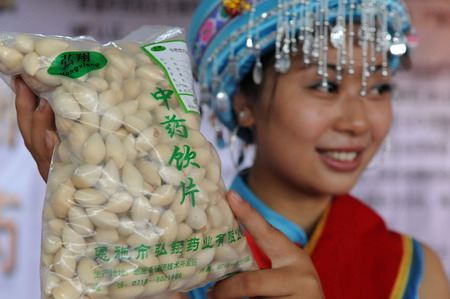
The year 2010 has seen enormous fluctuations in the price of traditional Chinese herbal medicines, price changes that have put pressure on people who need them for their health, but have benefited traders in the time-honored remedies.
A report released in November by China's Association of Traditional Chinese Medicine found that the cost of more than 25 percent of herbal medicines more than doubled in the second half of 2010.
The city of Bozhou, in East China's Anhui province, has been known as the nation's center of traditional Chinese medicine since the 1980s. Its trade center for these medicines, the largest in the country, attracts thousands of herbal-medicine growers and traders at 8 am each morning.
"More than half of Bozhou's residents have been in the herbal-medicine trade for many years," said Li Yunling, a former wine seller.
Li became involved with herbal-medicine trading this year after learning that his neighbor earned more than a million yuan with it in 2009.
"This is an extraordinary year," said 64-year-old Cui Jubin, who has been a herbal-medicine trader in Bozhou for 15 years. He said only 2003 compares with it in terms of price changes - the price of radix isatidis, used to fight the flu, increased almost tenfold due to the SARS outbreak.
Cui started his trading this year with the Japanese Pagoda Tree Flower-bud, a common herbal medicine used to reduce fever. One of his partners had learned while visiting the Guangxi Zhuang autonomous region, a major producer of the herb, during the Spring Festival that supplies of the herb were likely to be scarce because there were fewer growers.
"A decrease in herb production usually leads to an inflated price, so I decided to buy some and wait for the price to rise," Cui said.
Cui bought 10 tons of the flower-bud for 20 yuan ($3) a kg and sold some of it for 60 yuan a kg. He earned more than he expected, 32,000 yuan in three months - a monthly salary of 2,000 yuan is considered good in Bozhou.
"Most herbal medicines are grown in the southwest of the country, which saw flooding and drought this year that reduced production," said Xing Zhenjie, owner of a research lab in Bozhou that guides growers in herbal-medicine cultivation. "Another key factor in this year's price increases is that some traders monopolized stocks of certain herbal medicines."
As an example, he mentioned radix pseudostellariae, used to treat stomach and spleen ailments, which went from 20 yuan a kg to more than 160 yuan. Traders who hoarded the medicine earned millions of yuan.


