Geithner talks 'focus on yuan'
 0
0 


Vice-Premier Wang Qishan held talks with US Treasury Secretary Timothy Geithner on economic ties on Sunday after a meeting of the Group of 20 finance ministers in South Korea vowed to avoid a global currency war.
|
|
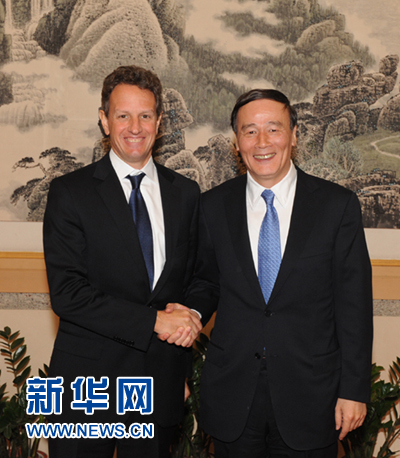
The impromptu meeting between Wang and Geithner, who are designated special representatives of their respective presidents on economic issues, also covered preparations for the Seoul G20 summit scheduled for Nov 11-12, according to a Xinhua News Agency report, which did not elaborate.
The meeting was held at Qingdao airport, Shandong Province, during a stop-off for Geithner after he attended a two-day meeting of G20 finance ministers and central bank governors, which ended on Saturday, in Gyeongju, South Korea.
Officials at the meeting agreed in principle to refrain from tit-for-tat currency devaluations and reduce trade and financial imbalances. They also agreed to give China and other major developing countries a bigger role in managing the global economy.
Pang Zhongying, an expert on international relations at Renmin University of China, said "Wang and Geithner might have discussed their stance on currencies, especially the yuan, before the opening of the G20 summit next month".
Geithner, Pang added, might have sought to see how much more the yuan would appreciate, something the US has been pressing for.
Washington has claimed that economic imbalances are the source of the global financial crisis and US economic problems, and suggests appreciation of the yuan is the solution.
The upcoming G20 summit in Seoul will focus on the currency issue, including the yuan dispute, Pang said.
The US has complained about, what it terms, intervention by some countries in their foreign exchange markets to prevent currency appreciation, and it has also sought to limit the trade surpluses of other countries in a bid to increase US exports.
However, many emerging markets are suspicious that the US has deliberately allowed the dollar to depreciate to benefit its exports. The dollar index has slumped to about 73 from 113 since 2002.
The dispute between the US and emerging countries is seen to be a possible prelude to a global currency war.
After all-night talks, the meeting on Saturday reached an agreement to "refrain from competitive devaluation of currencies" and aim for "more market-determined exchange rate systems".
The ministers and central bankers vowed, in a statement, to "pursue the full range of policies conducive to reducing excessive imbalances and maintaining current account imbalances at sustainable levels".
International Monetary Fund chief Dominique Strauss-Kahn said the G20 ministers had, in parallel, struck a "very historic" deal to revamp the organization to give China and other emerging powers a greater say.
Under the deal, Europe agreed to cede two seats on the IMF board to accommodate developing nations. Brazil, Russia, India and China will all rank among the top 10 IMF shareholders, with China third after the US and Japan.
The US would continue to enjoy a one-vote veto power within the IMF.
Analysts said the agreement reached in South Korea has achieved only "limited" progress with "empty" words and it is hard for its members to reach a workable consensus in the upcoming summit.
Chen Gong, chief economist at Anbound Consulting in Beijing, said the meeting of the finance ministers "failed to reach a concrete, workable agreement to translate their words into actions".
The statement issued after the meeting said advanced economies, that have reserve currencies, must avoid currency fluctuations that result in mass capital inflows into emerging markets.
At the meeting, Finance Minister Xie Xuren urged "major reserve currency countries to take responsible economic policies to ensure global financial stability".
The US Federal Reserve said it is prepared to loosen monetary policy if the economy remains weak. However, Rainer Bruederle, German finance minister, told the meeting that the Fed's push toward easier monetary policy is the "wrong way" to stimulate growth and may amount to a manipulation of the dollar.


