Experts discuss immigration at documentary film forum
 0 Comments


Three experts spoke about immigration issues in the world, particularly those related to China, at the German-Chinese Documentary Film Forum on November 27. The theme was "Globalization-Migration-Home" and was held at the Department of Culture and Education of the German General Consulate in Shanghai.
 |
|
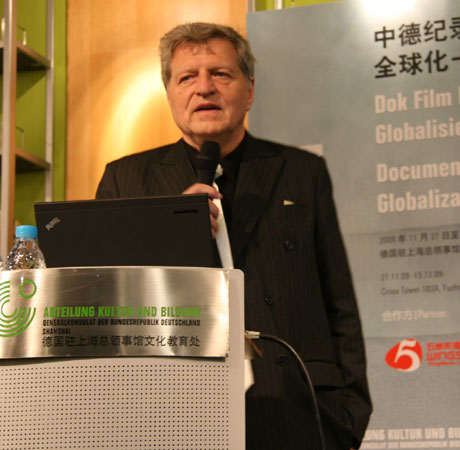
Dr. George Erber speaks at the German-Chinese Documentary Film Forum at the Department of Culture and Education of the German General Consulate in Shanghai, November 27. [China.org.cn] |
German economist Dr. George Erber said that the immigration population around the world would reach 214 million by 2010, with 128 million immigrants in developed countries and 86 million in developing nations. However, there will only be about 686,000 immigrants living in China at that time, so immigration will not pose problems in China, Erber said.
Yet the country is facing another challenge – urbanization. This trend is accompanied not by the relocation of foreigners, but by the relocation of China's own countryside populations to the cities. Erber said that the number of migrants would increase from 103 million now to 243 million by 2025 in China. As a result, about 50 percent of urban residents will have migration backgrounds. The great population surge in cities will put tremendous pressure on urban real estate and job markets. Erber also noted that the newcomers will face the challenge of building social networks in new communities.
 |
|
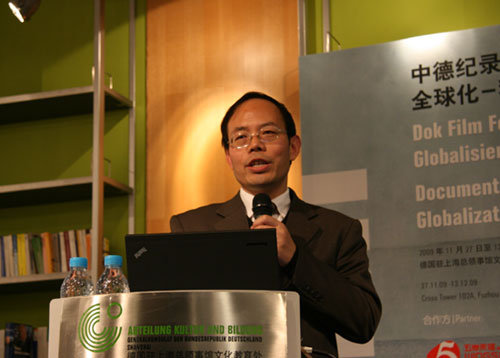
Dr. Zhou Haiwang delivers a speech at the German-Chinese Documentary Film Forum at the Department of Culture and Education of the German General Consulate in Shanghai, November 27. [China.org.cn] |
Dr. Zhou Haiwang, a population expert, referred to the migration situation in Shanghai. He said that Shanghai has seen its migrant population increase enormously since the beginning of the 1990s. Currently, there are more than 6 million migrants in the city, accounting for about 25 percent of the city's entire population. Driven by economic incentives, migrants come here mostly from neighboring provinces such as Anhui, Zhejiang and Jiangsu provinces. Most of them work in the fields of construction, household services and security. They are usually not well-educated, having only completed middle school.
Zhou said that only a very small percentage of migrants to Shanghai have acquired a local hukou (permanent residency permit). By 2002, only 100,000 of them managed to do so. Meanwhile, migrants' living conditions have improved a lot. They have better social security and medical care services than they used to. Their children have equal opportunities with the local kids to enroll in primary and junior middle schools. Nonetheless, about 40 percent of them do not feel at home in Shanghai, Zhou said.
Zhou believes the number of migrants to Shanghai will continue to increase. The city will face various challenges concerning the environment, transportation, education and medical care, among many others. Housing prices, which are already as high as the city's sky-scrapers, are expected to continue rising in the next 20 years, he said.
 |
|
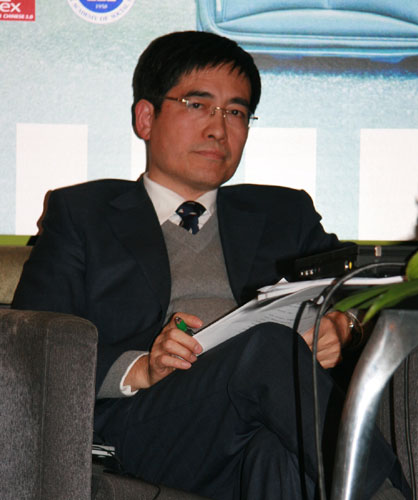
Dr. Tong Shijun listens to questions from the audience at the German-Chinese Documentary Film Forum at the Department of Culture and Education of the German General Consulate in Shanghai, November 27. [China.org.cn] |
Dr. Tong Shijun, an expert in modern Western philosophy, pointed out that disparities between economic interests and one's personal values often make it difficult for migrants to identify themselves with local people. Shanghai needs to create a more tolerant culture in order to allow migrants to feel at home, Tong said.
Zhou agreed with Tong. He said the local authorities should provide more help for migrants instead of setting barriers. In addition, he suggested Shanghai pay more attention to the education of migrants' children, and reform the hukou system to attract more talent.


