

 Share:

The Global Environmental Think Tank Development Report 2025 was officially unveiled in Beijing on Dec. 5, offering a comprehensive look at the global landscape of environmental think tanks and their pivotal role in tackling environmental challenges.
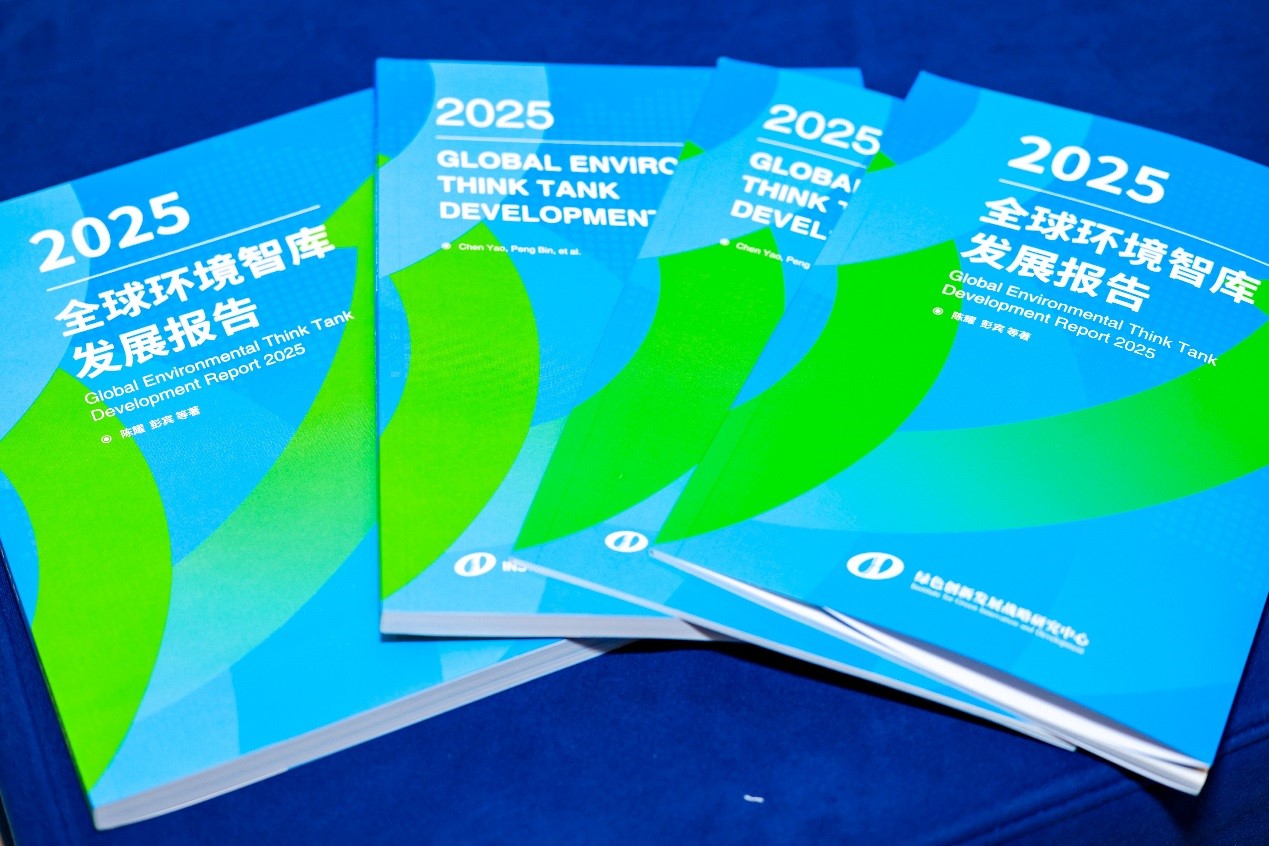
Copies of the Global Environmental Think Tank Development Report 2025, officially unveiled in Beijing on Dec. 5, 2025. [Photo provided to China.org.cn]
Launched by the Institute for Green Innovation and Development, a science and technology think tank co-established by Zhejiang University of Technology and the Chinese Society for Environmental Sciences, the report aims to foster cooperation and development among these crucial institutions worldwide.
Core sections include the evolution, current status, evaluation and outlook of global environmental think tanks.
A total of 896 environmental think tanks across 97 countries were analyzed and evaluated in the report, including 506 specialized and 390 comprehensive ones.
In terms of regional distribution, the Asia-Pacific region hosts the highest number with 282, followed by Europe with 255, and North America with 176. At the national level, the United States has the largest number of environmental think tanks, with China ranking second.
Adopting a methodology that blends quantitative and qualitative analysis, the report evaluates global environmental think tanks across four key dimensions: institutional profile, research output, policy engagement and public influence. Beyond providing an overall assessment, it also gauges their performances in five specific fields: environmental pollution control, biodiversity and ecosystems, climate change, sustainable development, and the clean energy transition.
As shown by the report, China's environmental think tanks are flourishing and demonstrating strong momentum, primarily driven by advances in ecological conservation and the emergence of new types of think tanks. Eight Chinese think tanks were recognized among the global top environmental think tanks. Chinese think tanks also performed positively in specific areas, with six ranked highly in both the fields of environmental pollution control and biodiversity and ecosystems, four in both climate change and sustainable development, and three in the clean energy transition field.
China's practices in the strategic research, technological innovation, policy consultation, and social services related to ecological and environmental protection and green development have provided new insights for the development of global environmental think tanks, according to the report.
In terms of future development, the report advocates for constructing an international partnership network and actively engaging in global environmental governance platforms.
By strengthening international cooperation, think tanks can broaden their research perspectives and resource platforms, thereby more effectively participating in the knowledge construction and policy advancement processes of global environmental governance, it said.
Erik Solheim, former under-secretary-general of the United Nations and co-chair of the EU-Asia Center Board, said that the report not only provides excellent analysis and evaluation of global environmental think tanks, but also showcases to the world China's achievements in building environmental think tanks.


 京公網安備 11010802027341號