Share:

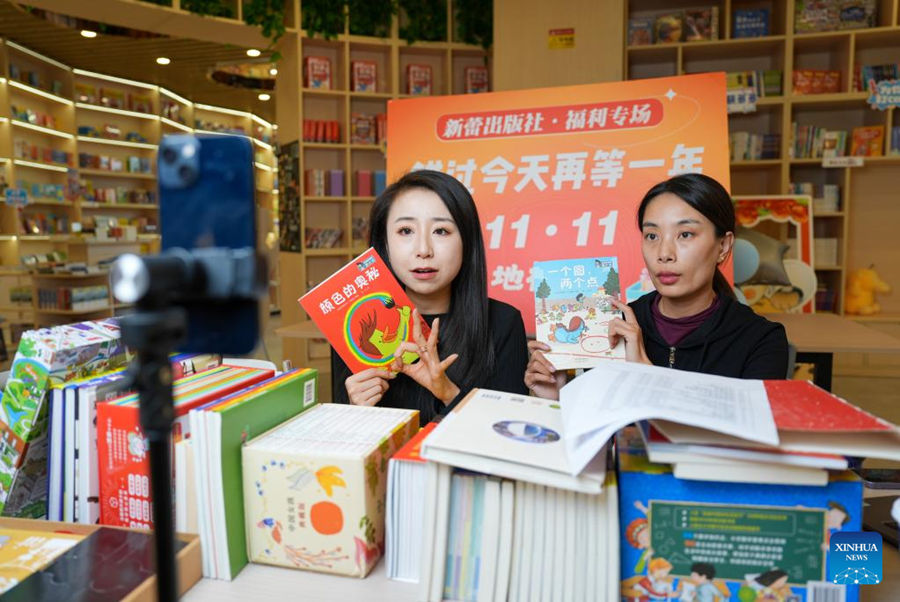
Women sell books via livestreaming at a reading space in north China's Tianjin, Nov. 11, 2024. (Xinhua/Sun Fanyue)
The term "直播帶貨" (zhíbō dàihuò) has captured great attention in China. Generally translated into English as "livestream e-commerce," this buzzword conveys the essential activity but only hints at its broader meaning. After all, livestream e-commerce is more than online shopping — it is a performance, a conversation and a shared social experience. It merges commerce with entertainment and connects directly to the long-standing tradition of turning marketplaces into stages in China.
Open Douyin, Taobao or Kuaishou at almost any time, and the phenomenon comes to life. Streamers demonstrate products, offer playful commentary, answer real-time questions from viewers and encourage viewers to make purchases. Fans respond with emojis, virtual gifts and messages, creating an interactive atmosphere that recalls a lively market scene, yet within the comfort of one's own home.
In China, "直播帶貨" is more than a marketing tool. It is a social ritual and a form of cultural participation that involves entertainment, engagement and interactive storytelling. While the translation accurately conveys the activity, further explanation is required to appreciate the social, performative and emotional dimensions embedded in the practice.
The roots of livestream e-commerce extend far beyond digital platforms. Long before smartphones, China had a vibrant culture of street hawking (叫賣文化, jiàomài wénhuà). Markets in the Song (960-1279), Ming (1368-1644) and Qing (1644-1911) dynasties were alive with vendors calling out rhythmic slogans, reciting jingles and performing small acts to attract attention. Consumers were drawn not only by products but also by the entertainment itself. A vendor's success depended as much on personality and engagement as on the quality of the goods. Commerce was intertwined with performance, trust and social connection — a foundation that livestream e-commerce continues to build upon.
Modern livestream anchors are in many ways heirs to this tradition. Live chats replace the crowd; virtual gifts echo money given to performers; and anchors' gestures and humor evoke the energy of physical marketplaces. A successful livestream acts as a performance that fosters trust, draws viewers into a shared experience and creates a sense of community. In this context, livestream e-commerce is both innovative and culturally rooted, blending digital technology with centuries of social practice.
The concept reflects broader socio-economic transformations in China. With rapid technological development, livestream e-commerce enables farmers to sell produce directly to urban consumers, allows entrepreneurs to develop businesses based on personal charisma, and gives brands an interactive platform to engage audiences. Entire industrial chains, from logistics to packaging to marketing strategies, have adapted to the livestream model. It is not merely a commercial trend; it illustrates how China's economy evolves in response to technological, social and cultural forces.
The emotional dimension is equally significant. Consumers often develop personal connections with anchors, trusting their recommendations, enjoying their humor and participating in online communities. For viewers, livestreams provide entertainment, social interaction and a sense of belonging. Without understanding this context, those outside of China may see "直播帶貨" as a technical innovation only, overlooking the human-centered, culturally rich dynamics that define it.
Historical parallels reinforce this understanding. Classic works of art such as the 12th-century scroll painting "Along the River During the Qingming Festival" depict bustling streets where merchants called to passersby, performers entertained crowds and interaction was lively and social. Modern livestreams replicate these dynamics digitally, while technology allows millions to participate simultaneously. And yet, the human energy, humor and performative spirit remain central.
The surge of livestream e-commerce during the pandemic further highlights its social value. With many people staying home, anchors became companions as much as sellers, providing entertainment and a sense of connection. For residents in smaller cities or rural areas, livestreaming offered access to goods and experiences that might otherwise have been unavailable. "直播帶貨" became more than a business model; it became a cultural phenomenon. Understanding the term provides insight into China's digital economy as both innovative and socially engaged, rooted in a long cultural and historical tradition.
In essence, "直播帶貨" bridges old and new, digital and traditional, commerce and performance. Modern anchors entertaining millions online are heirs to traditional hawkers whose rhythmic calls once animated city streets. Virtual gifts echo money given to performers, and online shopping festivals reflect centuries-old market fairs. The practice invites global audiences not only to see what China sells but also to understand how it entertains, engages and communicates socially.
The term has become a story in itself, providing a lens through which to observe a modern, dynamic and culturally rooted China. It is, in every sense, a buzzword that tells a cultural story.
Dr. Shamuratov Shovkat is a researcher in international trade and economics at Jiangxi Fenglin College of Foreign Economy and Trade in Jiujiang, China.
Opinion articles reflect the views of their authors, not necessarily those of China.org.cn.


 京公網安備 11010802027341號