 Share:

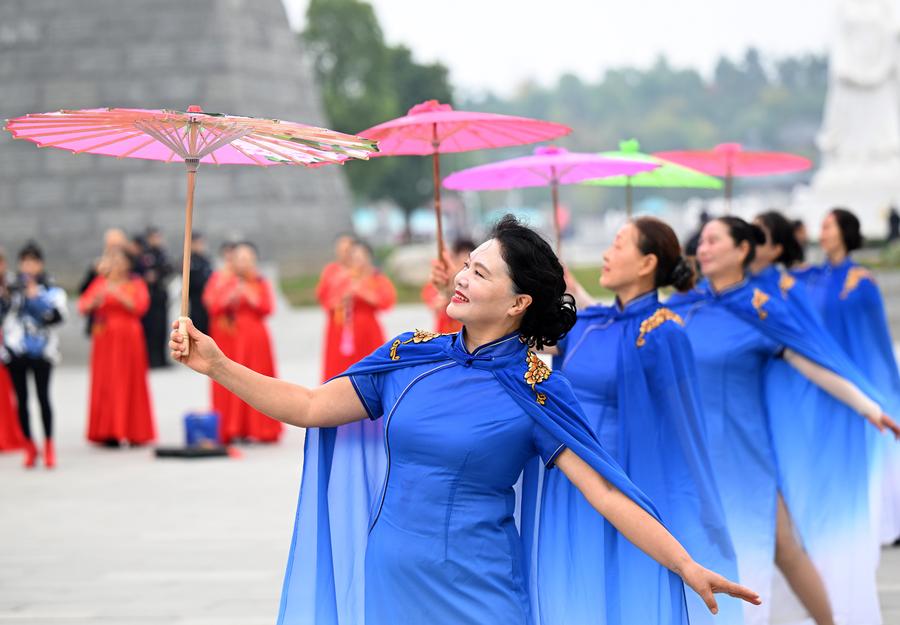
A model team formed by senior enthusiasts performs during an event celebrating Chongyang Festival in Xiping County, central China's Henan Province, Oct. 29, 2025. [Photo/Xinhua]
For 62-year-old Ms. Tian, every day begins with a cherished ritual: a morning face mask, a cup of black coffee, and then attending a flower-arranging class.
Recently, she even purchased a semi-permanent eyebrow tinting service online. "It just makes me look more refreshed," she said.
While some people still assume that older adults are thrifty by nature, a quiet shift is rewriting that stereotype: seniors have become one of the most dynamic forces in China's consumer market.
Especially among the 50 to 60-plus age group -- better educated, financially secure, relatively healthy, and no longer satisfied with "basic survival" consumption -- pampering oneself has become an important part of what they envision for later life.
Today, their shopping bags are no longer filled with discounted items. Instead, they often contain high-end cosmetics, fine clothing, and premium outdoor gear.
Ms. Wu and her husband are avid hikers who have been fond of traveling since their youth. Now retired and with plenty of free time, they have traveled all over China and explored far-flung places like Antarctica and Africa.
"Every year we plan a major trip, and short local hikes are a monthly must," said Wu, who looks far younger than her 63 years, her voice brimming with cheer and energy.
To adapt to different climates and terrains, they keep upgrading their gear, from heavy-duty jackets and hiking boots to hats and trekking poles. A full set can cost anywhere between several thousand and tens of thousands of yuan.
"After years of savings and with no grandchildren to care for yet, we want to make the most of it and take as many trips as we can," she said. In China, it's common for grandparents to co-raise children.
Data shows that senior citizens now account for more than 20 percent of all domestic tourists in China. In the first half of this year, revenues from tourism services, sports and wellness services, and cultural and recreational activities tailored for the elderly rose roughly 26 percent, 24 percent, and 21 percent year on year, respectively.
China's growing elderly population is fueling massive market demand. By the end of 2024, the number of people aged 60 and above had reached 310 million, accounting for 22 percent of the total population.
A report estimates that China's silver economy is currently worth about 7 trillion yuan (about 989 billion U.S. dollars). By 2035, it could reach 30 trillion yuan and account for 10 percent of the country's GDP.

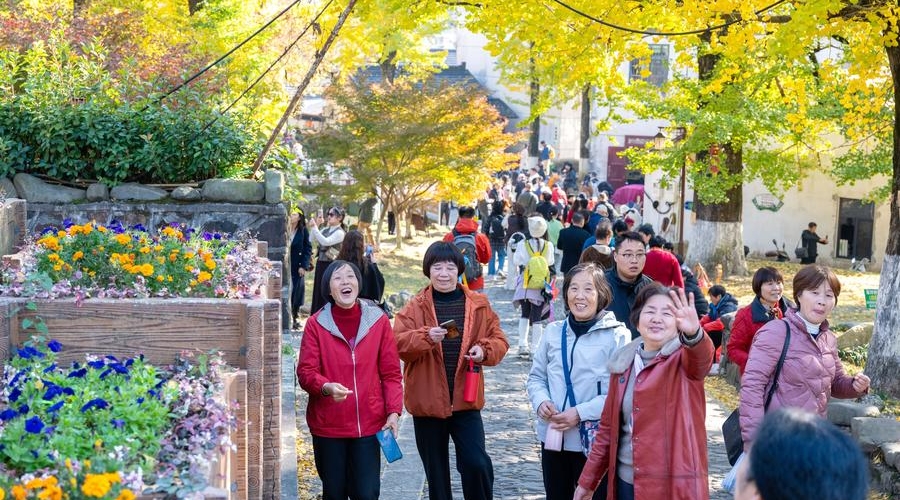
Tourists visit a scenic spot featuring ginkgo trees in Xiaopu Town of Changxing County in Huzhou City, east China's Zhejiang Province, Nov. 20, 2025. [Photo/Xinhua]
Also enthusiastic about investing in herself is Ms. Xie in Wuxi, east China's Jiangsu Province. Retired from a hospital four years ago, she is ready to spend money on things that bring her joy.
Just recently, she purchased a skincare package at a beauty salon that cost more than 10,000 yuan. "I hesitated at the checkout," she admitted, "but at this age, isn't happiness exactly what we should be paying for?"
She believes those in their 60s are actually the "big spenders." Not only have they benefited from decades of economic growth, but many have also paid for their mortgages and children's education.
At the same time, this generation has very different attitudes from their parents: as long as they maintain some savings, they are more willing to spend on health, emotional well-being, and an enjoyable lifestyle, Xie said.
According to Lu Yuan, an associate professor at Nanjing University's School of Social and Behavioral Sciences, this generation benefited from China's reform and opening up and the development of the social security system. Their pensions and medical coverage provide a stable financial foundation for their spending habits.
"They still see themselves as in the 'late-middle-age' stage. Their youthful, open mindset drives them to use consumption as a way to redefine self-identity and the boundaries of age," he said.
The Chinese authorities are also moving quickly, strengthening policy design and implementation.
In 2024, the State Council released a document on promoting the silver economy, expanding the concept from traditional elderly services to a "pre-aging economy" that includes people aged 50 to 60. The shift signals that the silver economy is an extensive life-cycle planning beginning in midlife.
In October, the Communist Party of China Central Committee adopted its recommendations for formulating the 15th Five-Year Plan (2026-2030) for national economic and social development, which once again emphasized developing the silver economy, elevating it to a national strategic priority.
Ms. Liu, a recently retired media professional, often buys herself new clothes, bright lipstick, and elegant scarves.
She found resonance in British writer Diana Athill's memoir, Somewhere Towards the End, where she learned that growing older is not the dimming of life, but is another opportunity to bloom.
"The desire to dress up means you refuse to give in to a passive old age, and the way you spend money reveals that your life is still full of vitality," Liu said.


 京公網(wǎng)安備 11010802027341號